

THE GREAT MEASUREMENT GASLIGHT
How the past week has proven it's time to burn TV measurement down

Happy Monday Peaceniks.
A serious question: What the actual fuck is going on at Nielsen and the MRC?

If you work in or follow the American television industry, you know that the entire business is held captive by two organizations: the measurement monopoly Nielsen, the only universally accepted measurement metric and advertising currency; and the Media Ratings Council (MRC), the lone “self-regulatory body,“ charged with overseeing Nielsen and anyone else who attempts to compete with TV’s measurement monolith.
For years, I have covered this incestuous relationship in this newsletter.
Yes, there are other measurement and currency companies in the US. Yet, due to the television industry’s self-destructive addiction to the status quo, their inability to see past the edge of their own double-dealing boondoggles, and because of the MRC’s long-standing protective relationship with Nielsen, no other TV measurement platform can pry enough business out of TV’s smoke-filled back rooms to challenge the King and Courtesan. Therefore, all of us (myself included) have no choice but to rely on Nielsen to tell us what happens on American TVs.
We have become utterly dependent on Nielsen’s monthly Gauge report, as the central signpost for how television consumption is changing. We all readily admit to each other that it’s pretty much bullshit. But, for whatever it’s worth, it is the only BS we have for directional guidance on the evolving transformation of viewership.
I have detailed my criticisms of the Media Ratings Council and Nielsen here, here, and here. I have tried to work with the likes of VideoAmp and Comscore to create useful alternatives to The Gauge. Yet, the other players have repeatedly proven themselves too unfocused or feckless to take advantage of the gaping whitespace, instead killing those products in the crib.
A year ago, after rampant examples of the MRC’s unwillingness to protect television from Nielsen’s famous shortcomings, I called on the television industry to mothball the Orwellian-sounding Media Ratings Council.
I got angry pushback from Trad Media loyalists (see the comments at that link). The MRC and Nielsen demanded to meet with me to “correct” my perpsective. I fought as hard as I could against the current. But, to be honest, given the industry’s collective, immovable inertia, and lacking any realistic alternative, I resigned myself to utilizing the only set of bullshit metrics everyone in TV agrees to hold their noses and use.
Then, this month, suddenly and without warning, the heavy doors of TV’s Habsburg palace burst wide open, exposing a tornado of petty infighting among measurement’s inbred royalty - proving just how profoundly dysfunctional the foundational relationship between Nielsen and the MRC truly is.
Before I offer my take on this television dumpster fire, for those not yet fully caught up on TV measurement’s ongoing telenovela, here is a full recap (SPOILER ALERT!) from the previous and current seasons of TV’s craziest soap opera:
Dec 2020: Nielsen announces its Big Data solution is ready, claiming it will “revolutionize measurement” by integrating data from millions of smart TVs and set-top boxes, and that their legacy panel would eventually “fade out.”
May 2021: Nielsen unveils The Gauge - a high-level monthly snapshot of total TV usage. Since then, it has evolved into an industry touchstone - one that I utilize myself for directional tracking. In reality, given numerous limitations and omissions, The Gauge is, in fact, simply “vibe metrics,” generating countless opinions, while offering little actionable data.
Sept 2021: Under enormous pressure from its members, the MRC strips Nielsen’s accreditation for national and local ratings, after Nielsen admits to undercounting audiences during the pandemic.
July 2022: For the first time, streaming surpasses cable (34.8% vs. 34.4%) in total viewership on The Gauge - garnering the largest share of TV consumption of any of the three major formats.
2022–2023: Nielsen continuously pushes back the rollout of its Big Data solution, citing “readiness issues.“ The Video Advertising Bureau calls “Nielsen’s Big Data + Panel the Worst-Case-Scenario.” Nielsen and the VAB get into an ugly, public pissing match.
April 2023: Ignoring widespread industry skepticism, the MRC reinstates Nielsen accreditation, just in time for the Upfronts (what a coincidence!). As history has come to prove, this reinstatement was biased and unmerited.
Aug 2023: In a post titled Gauging Acumen, I demonstrate how The Gauge is an often misread and misunderstood ‘shell metric,’ due to Nielsen’s terminological conflation and obtuse refusal to include viewing by age demographics. This failure to provide generational consumption masks a widening chasm in media usage and plays a key role in the current season’s melodrama.
March 2024: Despite all evidence of Nielsen’s rampant shortcomings, the 4A’s issues a report declaring that “The Shift To Multi-Currency TV Ratings Is ‘Not Ready For Prime Time’,” which I proceed to debunk in a post in this newsletter as “dangerously antiquated propaganda for the status quo.”
May 2024: Nielsen launches The Media Distributor Gauge - aggregating viewing by parent company. Before it drops, someone leaks me an early version of the Distributor Gauge, which allowed me to critique it before the wider industry reads it, specifically noting how much TV viewing The Gauge misses entirely.
July 2024: YouTube becomes the first streaming platform to crack 10% share of total TV on the July 2024 Gauge.
Sept 2024: For the first time, YouTube reaches #1 on the Media Distributor Gauge (10.4%), beating Disney and NBCUniversal.
Fall 2024: The MRC first kicks off a review of Nielsen’s Big Data solution, at first refusing to accredit them after discrepancies in demographic weighting emerge.
Jan 2025: Five years after saying it was ready, and promising that their antiquated panel was “phasing out,” Nielsen announces that its Big Data currency was finally launching. But, rather than doing away with the panel, Nielsen says they are combining the two platforms into a Frankenstein monster called “Big Data + Panel.” The panel isn’t “fading out,” rather it’s now the “truth set” used to clarify their wonky Big Data solution.
Jan 2025: The Orwellian-sounding Media Ratings Council - ignoring countless, glaring red flags that they themselves had previously called out - announces they have accredited Nielsen’s “Big Data + Panel” dinner-theater hybrid, just in time for the coming Upfront season (another coincidence!).
Feb 2025: YouTube reaches a record 11.6% share of total TV in the February 2025 Snapshot. It has held the top spot on Nielsen’s Distributor Gauge every month since.
May 2025: In a historic moment for television, our industry’s only universally shared metric, The Gauge, shows that streaming (44.8%) surpassed the combination of both broadcast and cable (44.2%) for the first time.
Sept 2025: After seeing significant discrepancies in demographic weighting and delivery during the first half of 2025, the MRC informs Nielsen it must implement several critical changes to their methodology - including the adoption of an independent third-party universe source - to maintain accreditation.
We have since learned that, at the time, the MRC insisted that Nielsen specifically utilize the ARF (Advertising Research Foundation) DASH study, conducted by NORC, to provide the television universe for its ratings. (I provide details on this study and why it was chosen below.)
Dec 2025: Streaming reaches a record 47.5% share of TV on Nielsen’s Gauge. According to Nielsen, twice in the month of December, streaming surpassed a 50% share of all TV consumption for the first time in history.
Jan 2026: The MRC accredits the DASH study, establishing it as the new independent benchmark for the TV household population “denominator.”
Feb 2026: Nielsen integrates DASH. The new results show dramatic variances to Nielsen’s previous measurement. Streaming services drop significantly and suddenly, Trad TV - the combo of cable and broadcast - reaches 47.4% of TV viewing, surpassing streaming (at 41.9%) for the first time since April of 2025.
Early March 2026: Nielsen informs its clients of the seismic shift. They explain that the integration of DASH data was one reason, but that the combination of the Super Bowl and Winter Olympics were other contributing factors. Nearly every single client, including many who sit on the ARF board, freak the fuck out.
March 13, 2026: Facing a revolt from streaming platforms like YouTube and Netflix, Nielsen announces they will delay the February Gauge report by one week (to March 24) to provide “additional data” to concerned clients.
March 19, 2026: Someone leaks the data to the WSJ, who reports that the delayed data shows Trad TV back on top, that YouTube reportedly dropped from 12.5% to 11%, and Netflix fell from 8.8% to 7.5%.
March 20, 2026: Nielsen’s Chief Client Officer, Peter Naylor, informs clients of a complete reversal and retreat. To “minimize trend breaks”, (hyper-deliberate double speak) Nielsen announces it will not make any methodological changes for the February Gauge (now delayed until April) and will instead use the same methodology it has been using, until fall of 2026 - when it will then integrate the DASH data into its measurement.
To better clarify the stakes of this drama, here is some important background on all the members of this love-hate triangle:
NIELSEN: You probably know them. But it’s important to understand that their controversial “Big Data + Panel” solution includes panel data from 42,000 homes who volunteer to have their actual device usage tracked, combined with “Return-Path Data” (RPD) from set-top boxes from Comcast, Spectrum, DIRECTV, and DISH, and “Automatic Content Recognition” (ACR) screen-level data from Roku and Vizio.
While the panel data allows Nielsen to “know who’s watching,” the historic issue many of us have, is their filtered (read: biased) choice of homes included in the panel. This issue is exacerbated by the inherent problem with their "Big Data" solution: set-top boxes and smart TVs do not know who is in the room. They only know that the “TV is on.”
ARF/NORC/DASH: The DASH (Device and Account Sharing) study is syndicated research funded and managed by the ARF (Advertising Research Foundation) and executed by NORC (the National Opinion Research Center at the University of Chicago).
The DASH study is an ongoing, rotating panel of homes. It actually incorporates far fewer households than Nielsen - just 10,000 to 11,000 homes. However, unlike Nielsen’s panel, which is entirely remote and (more recently) digital (thus entirely reliant on respondents for accuracy and truthfulness), NORC utilizes a Mixed-Mode Methodology of online Surveys (for the digitally active), Phone Interviews (for less tech-savvy homes), and in-person, face-to-face door knocking, to capture households with no internet, ensuring older, rural, and low-income demographics are well represented. They also utilize longitudinal tracking of approximately 3,000 respondents, tracked year-over-year, capturing “switching” dynamics of people cancelling cable or adding streamers.
NORC is an independent, non-partisan research institution with an 85-year history of working with the US government and major news organizations, such as The Associated Press and Wall Street Journal. It should be noted that - due specifically to this Mix-Mode methodology - NORC-powered polls have been proven to be the most accurate and precise in the last few election cycles, accurately predicting the outcomes of the controversial 2020 and 2024 presidential campaigns, as well as the 2018 and 2022 midterms, contradicting nearly all other polls in the lead up to those votes.
NORC’s accuracy stems from their ability to survey THE UNREACHABLES. Their DASH survey tracks homes that pure-play digital tracking cannot - specifically digital resisters who do not have the internet and do not stream television. This is a key benefit of the in-person door knocking element of their methodology.
But here’s the problem with that for the MRC, Nielsen, and everyone who relies on them. That “unreachable cohort” is overwhelmingly populated by people over 65 and homes who lack the resources to pay for broadband access. These homes typically only utilize Trad TV (especially broadcast), and they tend to utilize Trad TV much more heavily than their digital counterparts. This does not make their usage any less valid, but these are typically not the homes that advertisers want to reach.
This is precisely what makes The Gauge in its current form, and in its new DASH-informed iteration (whenever TF that arrives) utterly useless. By not breaking down TV consumption by generation, The Gauge only shows how much television is delivered to screens - ignoring entirely who is watching, or, in fact, if anyone is even in the room. It’s fine as a cocktail party trick, but useless as an actionable insight tool. However and unfortunately, due in large part to rampant financial engineering now at the heart of the television measurement industrial complex, The Gauge remains the only common metric available.
THE MRC: The Media Ratings Council was formed before The Beatles appeared on Ed Sullivan. As I have written - and as the Council has proved this month in stunning fashion - they are decades past their sell-by date. Their dysfunctional, incestuous relationship with Nielsen, personified in bold headlines all month, has turned their ‘oversight’ of the measurement monopoly into an absolute laughingstock. It would be funny, if it weren’t so epically tragic for the rest of us.

A year ago, after the MRC demonstrated their clear bias, I called for it to be disbanded. My larger point, beyond the ineffectual nature of “The Council,” was that our television measurement is entirely fucked up, that it always has been, and that it is only getting worse.
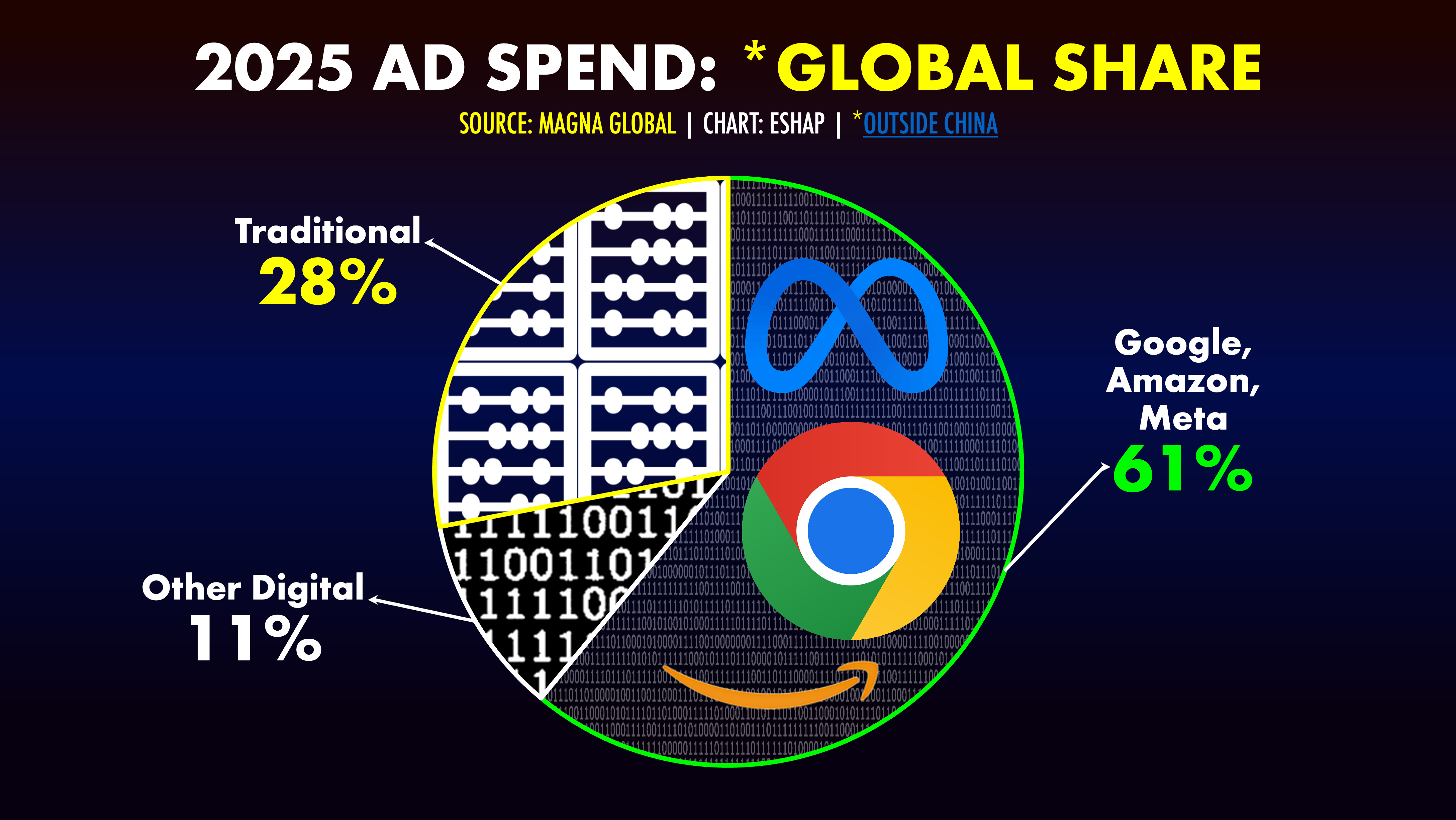
The old school media complaint that the “walled gardens grade their own homework” is hyperbolic and hypocritical. There is a lot to criticize about the way the Big Tech Death Stars run their businesses - I have done so, often, and repeatedly.
But those who spend their ad money on big tech platforms can prove the specific return on their media investments. Which is precisely why they all continually move more and more money from television to those platforms each and every year.
Last February, I declared, on camera, that it was time to put the MRC out to pasture.
My recommendation to everyone in the advertising and television industries was to mirror the big tech players - who were eating their lunches - and build measurement platforms, partnerships, and deals that best suited their own goals. My prediction was that Nielsen would continue to “fail up,” and that it would be up to those buying and selling advertising to work together to create solutions, among themselves, that allowed them to transact not based on the bullshit vanity metrics and monopolies of the past, but on the (get this) outcomes both sides wanted and needed.
When I said this, I took a lot of shit from many people in the industry who were too afraid to let go of the woobies they grew up with. Many of those mudslingers were friends of mine. They roared at me about the “proven track records” and “sound methodologies” of the MRC and its ratings board. They assured me that Nielsen had cured the mistakes in their past. (Their comments are still live.)
It is not easy to know you are right, when everyone else tells you, loudly, that you are wrong. In fact, it sucks. And, contrary to conventional wisdom, it is not any fun to say “I told you so,” when your worst case scenario prediction comes true. It is exhausting to keep telling the industry how fucked they will be, if they keep doing the same thing over and over and expecting different, better outcomes.
Yet here we are.
Even a broken clock is right twice a day. Although they did the right thing this time, the MRC knew about this huge Nielsen problem nearly a year ago. Yet they did fuck-all to fix it, until forced to.
Fold the MRC or don’t, but it is so obviously long past time for our business to stop paying them attention. They have obliterated whatever credibility they once had. Monopolies are bad, period. And, despite the industry’s inability to quit them, Nielsen continues to be the game of monopoly everyone in TV keeps losing.
Consumers have changed how content is consumed - totally and forever. The people who buy and sell TV advertising must do the same and finally transform the way they measure it. Advertisers and platforms can and should agree to grade each other’s homework, with methodology that serves both sides and produces - wait for it - tangible results; or they should be prepared to continue to lose to those who do.
By saying all of the above, I know that I am burning whatever bridges I had left to the measurement industrial complex. But those bridges only head in one direction: to the past. I say burn them all down.
Let me know what you think. And have a great week.
ESHAP
I’m with you Evan. Keep it up.
Notice how we have one of these each year in March aka a few weeks before the upfront season?! We should do another episode on measurement on the pod