THE MAP FORKS
The Latest Media Map Shows Two Possible Paths
Happy Sunday from sunny Lisbon! To celebrate my global travels, here is my newest Map of The Media Universe.
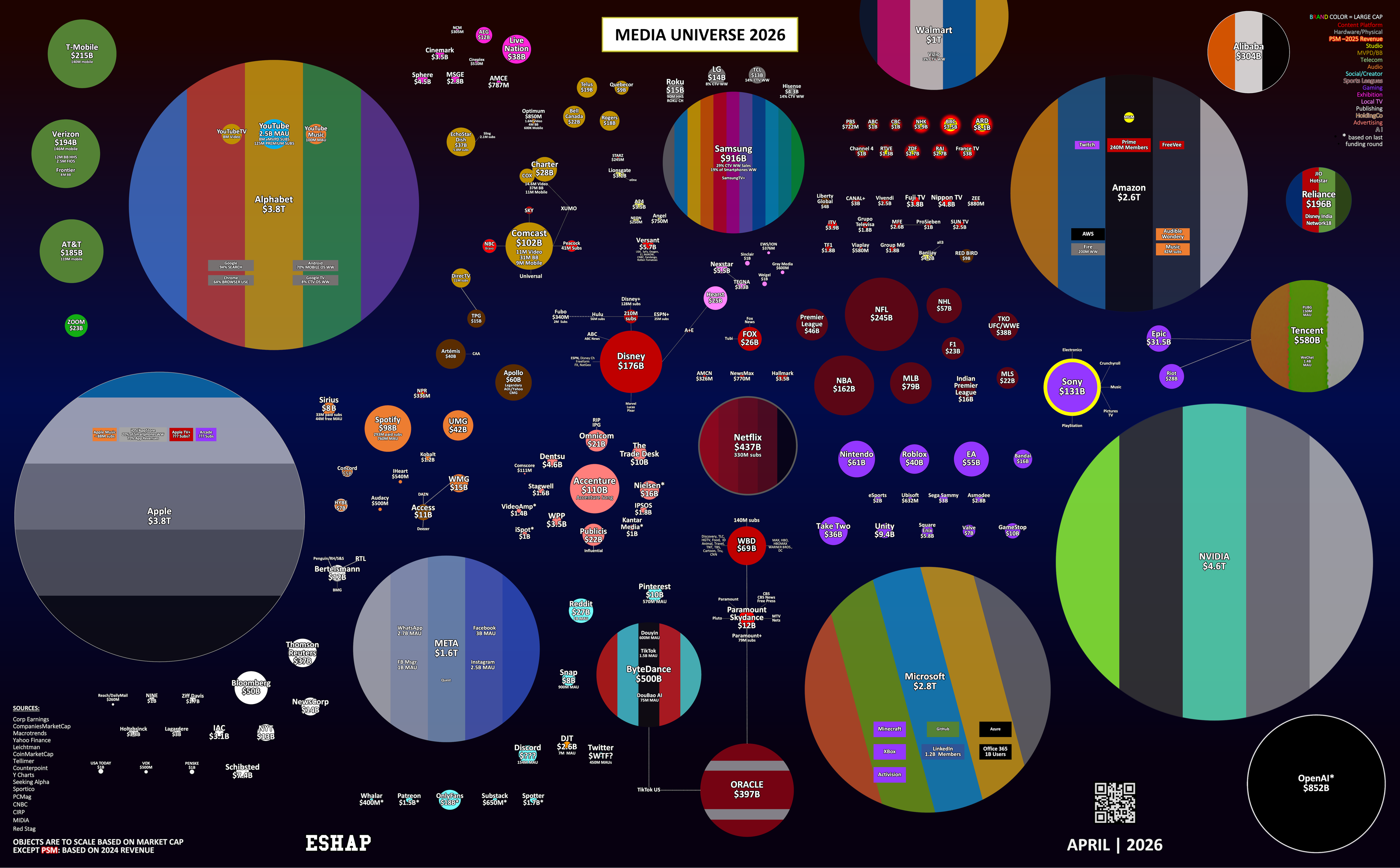
This version is low resolution. You can get high res maps going back to 2020, here.
Each version of these maps is drawn with the intent of showing what is happening right now - not what will happen, but rather what’s going on today.
The first map in 2020 showed that Big Tech had seized the center of gravity in the Media industry. It wasn’t a prediction, it was a report on the weather outside at that moment. Despite the math of it all, many in the Media community found that surprising.
This year, I drastically redrew the map, to better reflect the current currents of the ecosystem and portray what’s really happening, in real time. Today, using big tech platforms, audiences have merged mainstream and creator Media into one self-curated experience. This requires entirely reinvented business models for all Media - inside what I define as The Affinity Economy.
This new map, charting the recent, fast-changing fortunes for Netflix, WBD, Oracle, Paramount, NVIDIA, OpenAI, Samsung, Walmart, The Trade Desk, Omnicom, and Spotify, amplifies those currents.
The platforms and providers who put power in the hands of Users are solidifying their dominance in all aspects of distribution and consumption. Netflix walked away from one of the biggest and most traditional Hollywood deals in history and its market cap grew 37%. Meanwhile, the “winning” bidder has headed steadily in the opposite direction.
In fact, the battle over Disco Bros personifies something specific about this newly drawn Media Universe. Today’s map represents not just the merged Media ecosystem, where big tech, creators, mainstream, lifestyle, and commerce collide. It also lays out a major fork in the Media Universe, with two divergent paths - one forward, one back - for all players in the ecosystem.
THE FAMILIAR FORK: The Industrial Trap
The first path is the comfortable one. It’s the “OG Mogul” method. You keep doing what worked in the 20th century. You double down on legacy models, you fight the battle of mass-market reach, and you attempt to buy/merge/consolidate your way out of obsolescence. This thinking ignores what it fears finding out, relies heavily on vanity metrics, and vibe codes leadership.
But this trap isn’t just set for “old media.” It’s also a potential landmine for creators - still thinking that bigger is better than better. On this path, you get shackled to old models, mired in the muck of high churn, and measure audiences only as scale.
THE AFFINITY FORK: Depth is the New Scale
The second path requires a fundamental rewiring of the operating system. You lean into this brave merged world. You adopt the rules of the Affinity Economy:
Mainstream Media must think, act, and model like creators - nimble test-and-learn principles, a community-focused mission, super-serving the whole fan.
Creators must learn to think more like studios - building infrastructure, investing in sustainable IP, building diverse revenue models that add leverage.
Engagement eats Reach for Brunch.
Depth of Fandom is the new Scale.
Fortunately, this new Media Map offers us a quintessential case study in contrast for following either path.
The Case of Dueling Nepos: Fork Divergence IRL
The most stark demonstration of this fork in the universe can be found in two Media companies and two men who share theoretically identical DNA: Fox and Lachlan Murdoch, and Paramount and David Ellison. Both companies are run by dynastic heirs. Both are navigating the same legacy baggage. Yet, each have chosen very different strategies and forks.
Fox: The Affinity Pivot
I don’t love everything Fox does. I believe their news network is an existential danger to democracy. But, over the last five years, Fox has pivoted away from the Media apocalypse while watching Hollywood lemmings march straight for it.
Lachlan Murdoch is the nepo baby who chose the Affinity Fork. He (and his family) looked at the Industrial Trap and walked away. By selling the studio and cable networks to Disney, Fox freed themselves from the temptation to make broken models work, they unweighted themselves from massive debt and legacy systems.
Meanwhile, Disney fell directly into the Industrial Trap, with a ball and chain of debt, running on a never-ending hamster wheel of greater and greater scale.
This proves a key tenet of the Affinity Economy: Scale is not a model.
Yes, Fox held onto some truly legacy properties: Broadcast and Cable News. But, since the Disney sale, they are using the current cash from those businesses, and the sale, to fund a fan-focused creator-mindset portfolio with a billion-dollar balance sheet:
Fox Broadcast and News understand what they need to do. They focus on core-fandom. They over-deliver to superfans. Crucially, they continue to provide mountains of free cash flow which the company then has the vision to (get this) reinvest.
Tubi is transforming into Fox’s next generation of broadcast - with a Creator lab and a world-class expertise at building fandom.
Fox is not play-acting at Creators, like most in Hollywood. Their investments in Whalar and Lighthouse put them at the center of Creator culture and the brands who need them. Their investment in Red Seat Ventures provides Fox a model to monetize fandom.
Their significant investment in Holywater shows Fox Entertainment can redefine premium in the eyes of their audience. The combined deal they made with Dhar Mann Studios takes that fandom-first thinking to another level.
I’ve talked to countless execs at Fox. Lachlan Murdoch has established a culture where “trying something” is encouraged, failing isn’t punished, and “big swings” are celebrated. Right now, among legacy Media, that is a rare competitive advantage.
Despite primarily profiting from uber-traditional Media platforms, Fox’s Enterprise Value has surged 38% to $33 Billion since the Disney sale. By “pivoting to the User,” Murdoch has turned a legacy “Remainco” into an Affinity Economy model.
Paramount Skydance: The Mogul Myth
Conversely, ironically, David Ellison - the Big Tech heir - has chosen the Familiar Fork. Despite the Silicon Valley rhetoric, he is tripling down on the old-school Hollywood mogul playbook.
By hitching Paramount’s fortunes to WBD’s sinking ship, Ellison is attempting to scale his way out of a house fire. Yet, by riveting the two together, the nepo kid adds too much freight to fly:
He has traded agility for a $111 Billion mega-merger and $80 Billion in debt.
His only tech-like move since buying Paramount was buying a small Substack publication and giving its owner CBS news to run.
Rather than use his notable late night shows to transform late night, the way creators are doing all over the internet, he replaced Stephen Colbert with Byron Allen.
Rather than experiment and evolve broadcasting with Pluto TV, Ellison appears to be fading it into woodwork, sanding down the rough edges of fandom in favor of a top-down mandate called “One Paramount.”
Despite claims of building a “next generation entertainment company,” since Ellison took over, Paramount has not made any major Creator economy or tech investments. Instead they are bidding $111 billion for a legacy studio, spending billions more in legacy content, and demanding a consolidated tech stack for all of Paramount/WBD should the merger go through, promising $6 billion in savings - with no sign that Ellison or anyone there even knows what that means.
No one at Paramount really knows what the hell is going on. If there was a central vision when the Ellisons invaded, it’s been put on hold in favor of Junior’s Classic Mogul Dysmorphia. Remember, the main reason Paramount is paying so much for Disco Bros is because Ellison single-handedly bid up the price. The result is a culture of powerpoint binges, in-fighting, and chaos - exemplified by the noir-ish exit of Jeff Shell (only the best people!) this week.
He may be Ellison the younger, but Paramount is now run like a Media company from the 1980s, replete with foreign investors pulling the purse strings.
The price tag and tantrums make the Paramount/WBD saga a loud and obvious example of what not to do with your modern Media company, regardless of the era.
And yet…
Ellison’s actions are almost step-for-step like those of Bob Iger when Iger bid up the price for Fox beyond reason; of Brian Roberts when he paid far too much for Sky; like Shari Redstone who epically misjudged the value of legacy, or even like Sarandos when he chased WBD all over the lot like a teenager, despite no mathematical path to a model that made sense.
On the other hand, the Fox example shows that even the most traditional of Media companies, with the most legacy of platforms, can pivot their model to center on Users rather than shareholders, use current cash flow to invest in the future, while remaining balance sheet nimble, and avoiding the mogul trap.
Tomorrow, I’ll give the opening keynote at StreamTV, starting with this new map, highlighting this fork, using the Fox/Paramount comparison, and offering numerous other examples (like FIFA, Livemode, TF1, and Gaspard G) of companies and Creators, big and small, who are choosing the Affinity Fork.
Later this week, I will post the video of the whole keynote right here. Whether live or in the comments, I’d love to hear what you think!
Obrigado!
ESHAP


Great perspective as always, thank you