

YOU ARE NOT YOUR JOB
HOW TO UNDOCTRINATE YOURSELF FROM THE CORPORATE MIND-MELD

Happy Monday Peaceniks. Let’s talk about how to avoid this…
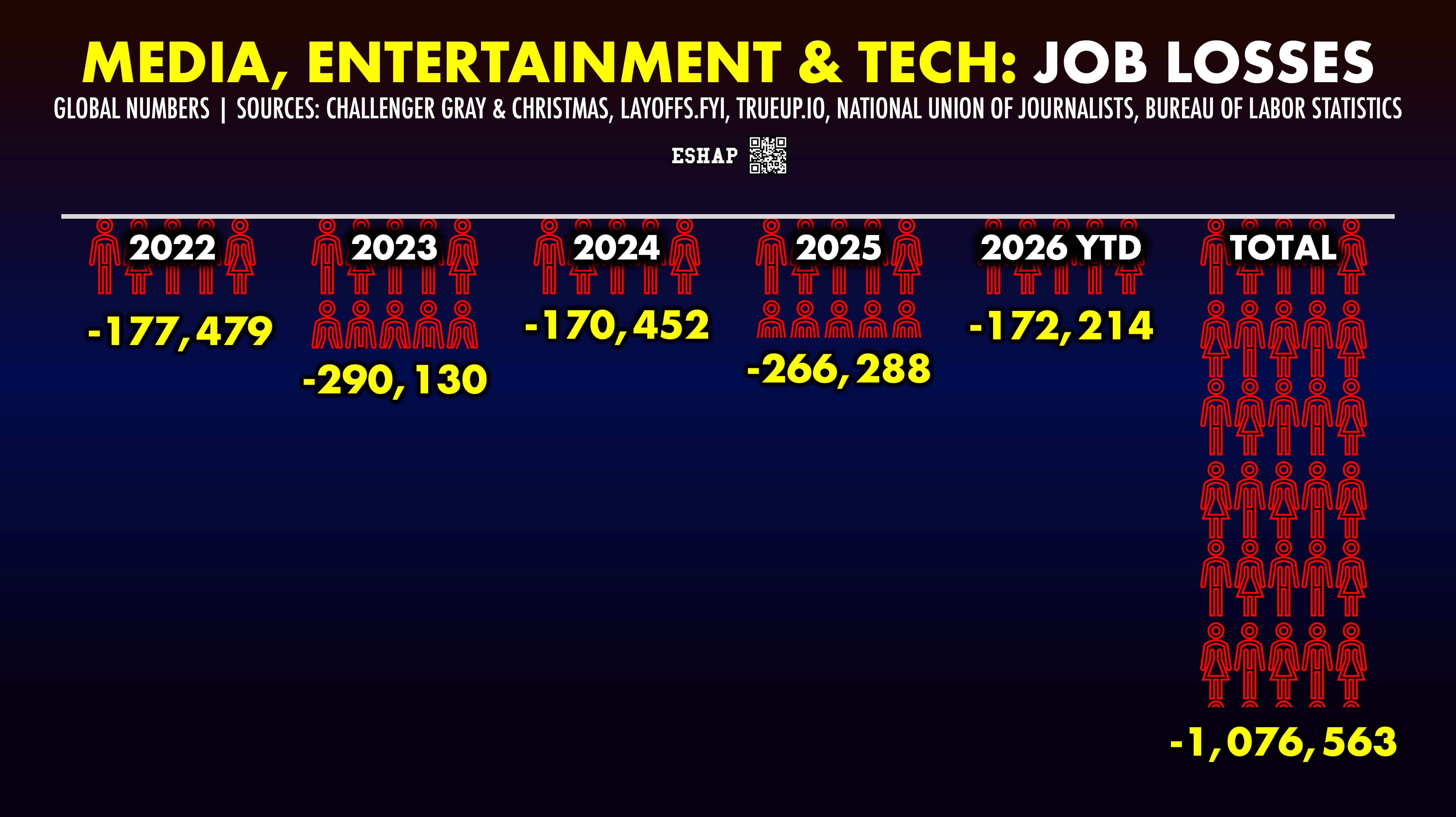
Over the last fifty-four months, globally, the media, entertainment, and technology sectors have shed more than one million jobs.
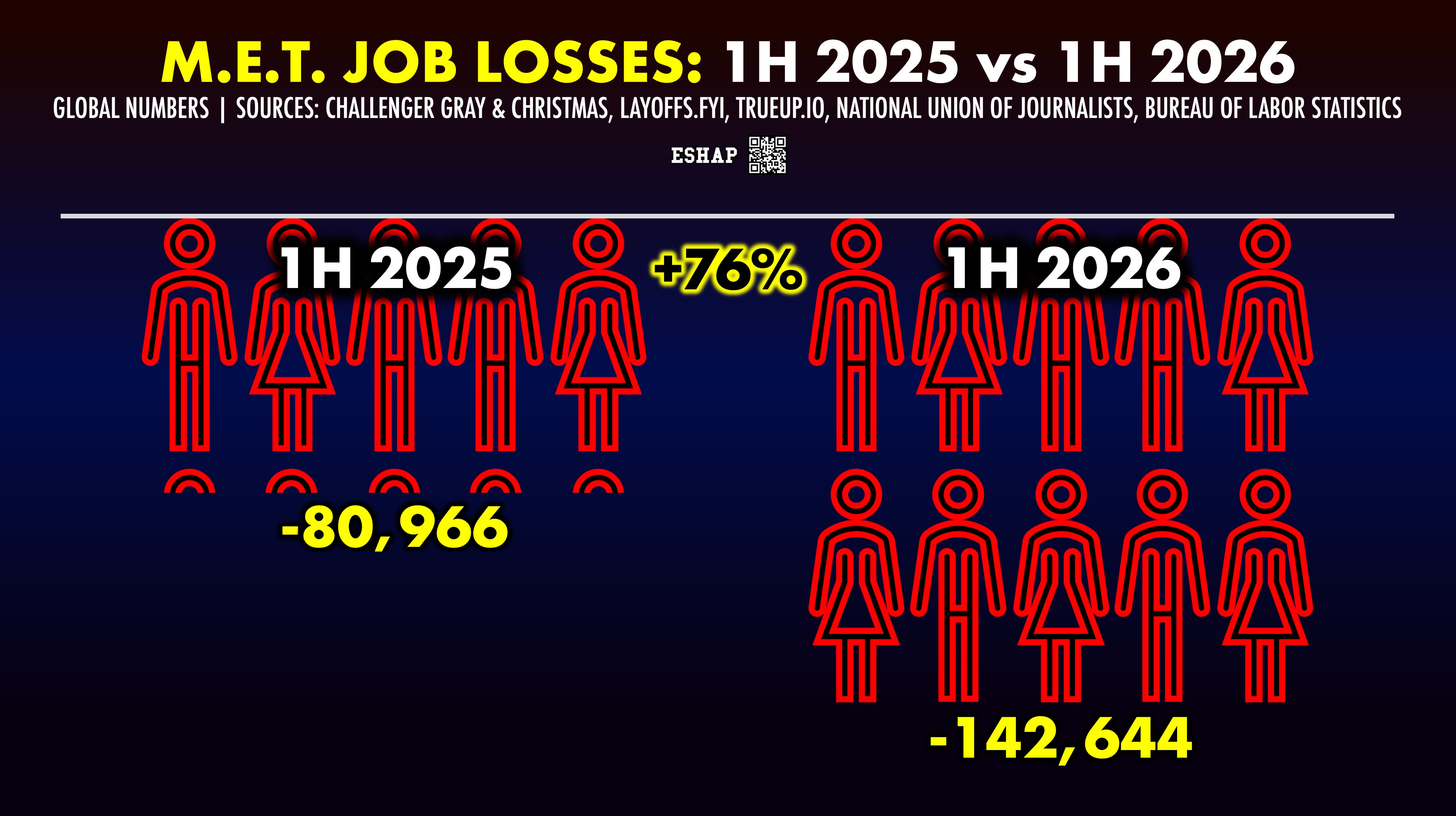
In January, I predicted that the shitcanning would get worse this year. Boy, was I right. In fact, the 2026 1H actuals — a devastating 76% surge in pink slips — prove that I underestimated the disaster.
For context, you should know that I too have been fired. A few times. Quite publicly…
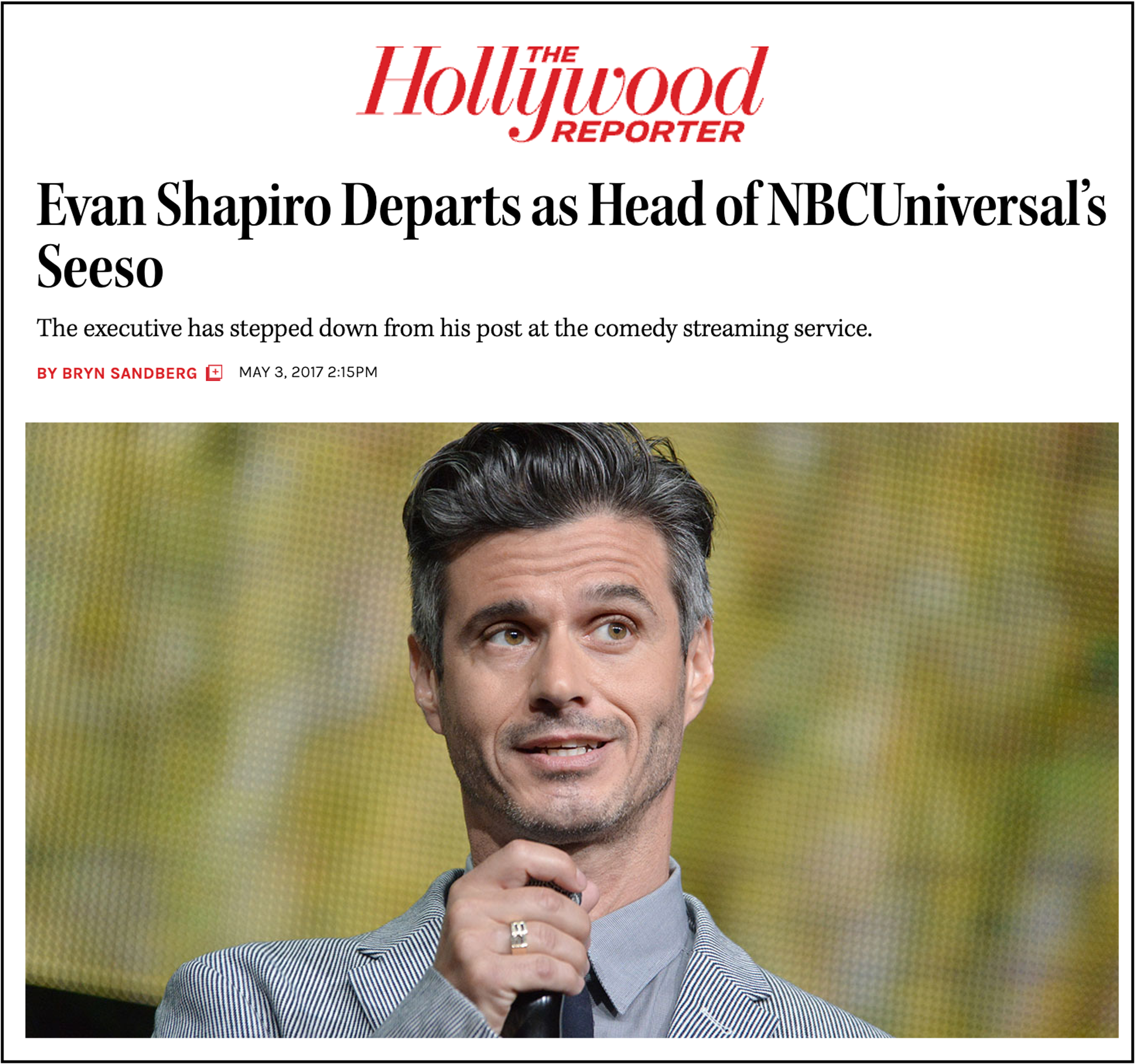
The last time I got shitcanned, by Comcast/Kabletown, it was on my 50th birthday. That was the last time I got fired, because that gig was also my last “job.”
I’ve been incredibly fortunate to have several very cool roles in the media universe — Director of Marketing for the New York Shakespeare Festival; head of my own agency; President of IFC and Sundance TV; President of TV for Participant Media, EVP of Digital Enterprises at NBCU.
I fell in absolute love with the authority, influence, money, and perks that come with big corporate titles — so much so, that chasing the next big promotion became central to my identity. Then one day, I woke up and found that I had been promoted past the things I truly liked to do. By that point, the politics of the company where I worked became the job. My team and I spent more time making decks and strategizing on how to “win the meeting,” than we did on the work itself.
Sound familiar?
This is now 99.99% of the time and energy spent by the most senior executives at many of the world’s biggest media and technology companies — this has been obviously true at the converging corporations in Big Media, journalism, and advertising, but it’s also increasingly the case, even inside enormously profitable Big Tech disrupters.
I spend a great deal of time in this space, detailing the reasons behind these failures of imagination. But today, I want to focus on you, specifically how you can avoid the shitcanning shitstorm of the next few years, by taking back control of your career and your life from the companies you work for and the bosses who will gladly toss you under the unemployment bus in order to salve Wall Street and keep their own overpaid jobs.
I will be holding a CAREER PIVOT LIVESTREAM tomorrow at 9:30a EST, right here on Substack — 100% free for all. I will post the video from that livestream right here on Media War & Peace on Thursday. More about that livestream below.
ALWAYS BE CLOSING EVOLVING
I am a college dropout with no formal education or training in media. I came to show business without any connections. I am also disproportionately ambitious. Throughout my career, this combination made me tremendously paranoid about competing with those alongside me, who knew more and were far better connected than me.
As I started to rise through the ranks of media, to combat the voices in my head and ensure I knew as much, or more, than everyone else in the room, I developed a process that would become my first line of defense and eventually a superpower:
WAKE UP STUPID EVERY DAY.
Thirty-three years ago, I got my first big job as Head of Marketing for The New York Shakespeare Festival — a job I did not earn nor deserve. I was 26 years old and absolutely panicked about failing. So, I started three daily rituals:
Each morning, I would get to the office before everyone else — not hard in the theater business — and spent two hours reading everything I could about the business I was in: articles, ticket sales reports, the zip codes of patrons, the rising trends in marketing.
Every day, I would strive to meet with at least one person I did not know, and talk to them about what they did, what they wanted, and what they knew.
Each night, after work, I would write — often in a stream of consciousness — about what these new pieces of information meant to me.
Though my techniques have changed over the years, I have maintained all three rituals, consistently, for more than three decades.
Those who have worked with me know that I will take a meeting with almost anyone — often, much to the frustration of those who work with me. Over the years, inspired by the great book The First 90 Days, I have developed my own interview framework for these conversations, asking each person the same five questions, in the same order. This allows me to transform dialogue into data.
I’ve also spent decades “autodidacting” myself into expertise about a range of topics about which I’ve become obsessed: digital media (in 1996, I launched the first Broadway website for Bring In Da Noise, Bring In Da Funk), generational power dynamics (in 2012, I was among the first in media to write that Millennials would end traditional television, in TV: An Intervention); and more recently, with analysis and predictions here on Substack (where I was one of the first to forecast that NVIDIA would be a trillion-dollar company, that YouTube would be TV’s biggest channel, and that Netflix would be having the exact troubles they’re in right now).
In 2008, against the wishes of my employer, I began teaching at NYU/Stern School of Business. I do love teaching. However, I started teaching specifically to access my own personal focus group of 18-22 year olds, once a week, year-round. Yes, I did strive to offer as much education to those students as possible. However, by constructing a curricula anchored exclusively on the real-time changes in the media industry, and in meeting with all 60 students, individually, every semester, I was able to create a two-way learning loop; the students learned what was really going on in media, and I learned how media’s newest consumers were actually consuming media. (Read that Intervention essay for a specific example.)
These three rituals of public re-education resulted in two crucial components of my professional life: 1) I was able to create a brand for myself that was bigger than the title I held or the company I worked for. 2) I often promoted trends long before the industry gave any shits about them.
In 2011, I begged AMC Networks to turn Sundance TV into a streaming platform. They laughed. At Participant Media, I urged Comcast, Time Warner, and other MVPDs to take our network aimed at Millennials and give it away for free to Broadband homes. They showed me the door. For two years, I told the industry that YouTube is TV. Many still angrily shove back at me (as recently as last week in my comments).
And that is precisely how I found myself out of a job, on my 50th birthday, after getting shown the door by my fourth boss at Comcast / NBCU / Kabletown.
Then, in 2017, faced with the choice of chasing jobs at companies that would not get me, or going out on my own, I chose the latter, and transformed myself into a Creator — a term that did not even exist at the time. It was not easy. Often it was the opposite of fun. But no one was looking over my shoulder nor telling me what I could or could not say. And as hard as it was, it was also beyond satisfying.
And that is where you find me now: a Webby Award winner for Thought Leadership who writes the newsletter you’re reading right now; who gets paid to say what I think, on stage, around the world; and gets invited inside the biggest companies in media and tech to tell them the inconvenient truths about the businesses they run.
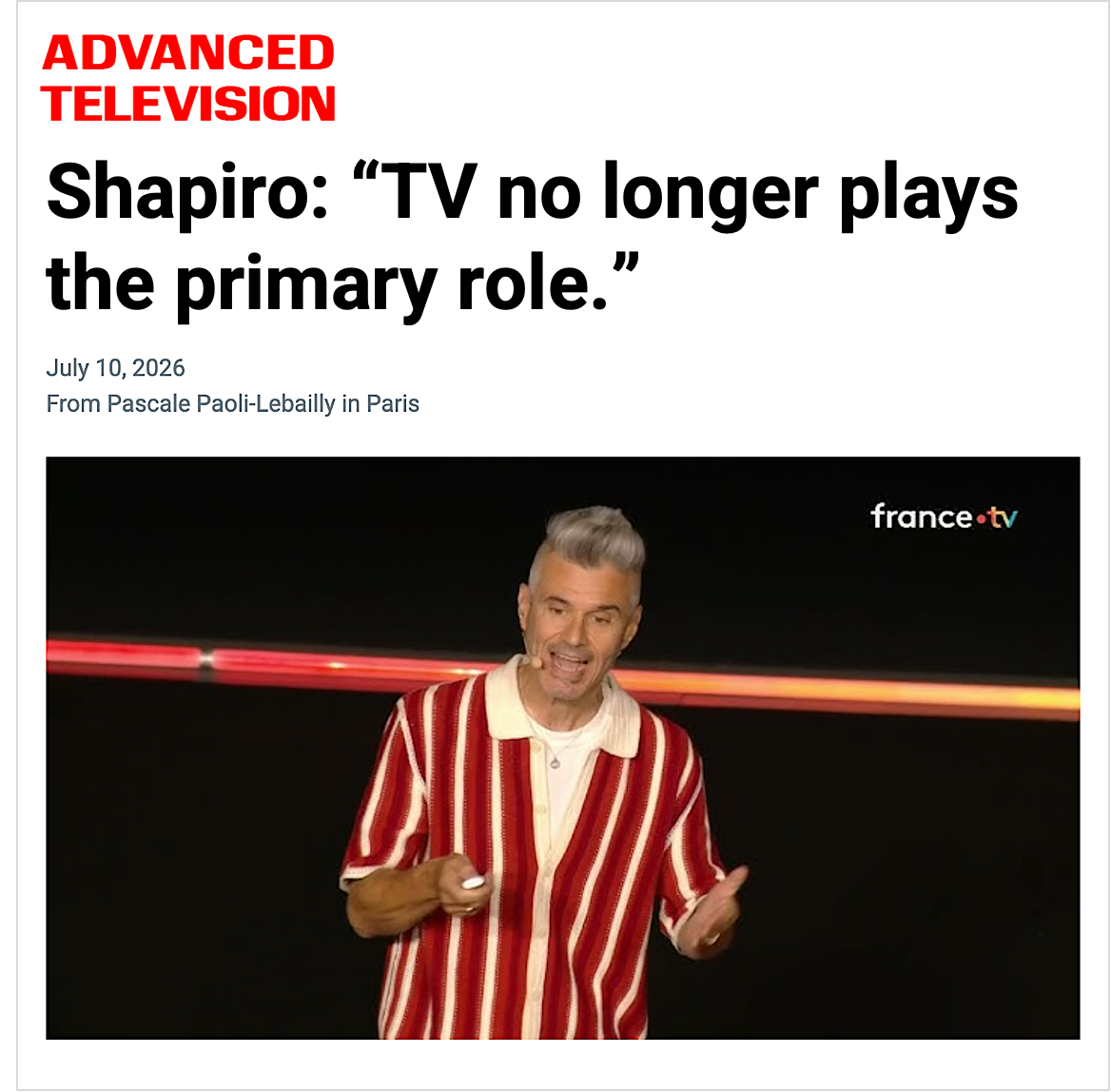
I work harder now than for any company who employed me. But, despite not having boss, nor an office, nor a fancy title, this is, by far, the most satisfying “job” I’ve ever had. And therein lies the lesson.
While you may hold no interest in becoming a Creator, nor starting your own business, nor provoking industry leaders to hold themselves accountable, within my own rituals, there is a framework — a blueprint — to take control of your trajectory and transform your job into a sustainable, satisfying career.
THE CARTOGRAPHER’S BLUEPRINT
Modern capitalism has morphed from a “free market” into a C-Suite enrichment scheme. Workforce wages have stagnated while CEO and CFO salaries have skyrocketed. Layoffs are now a shareholder communications strategy.
This is why Big Media and Big Tech don’t want you to be “too loud” on social media. This is why corporations spend less each year on employee development; annual employee development time is down 66.6% in the last five years. This is why CEOs and CFOs have bought the fallacy that AI can replace you, despite all available evidence that it cannot.
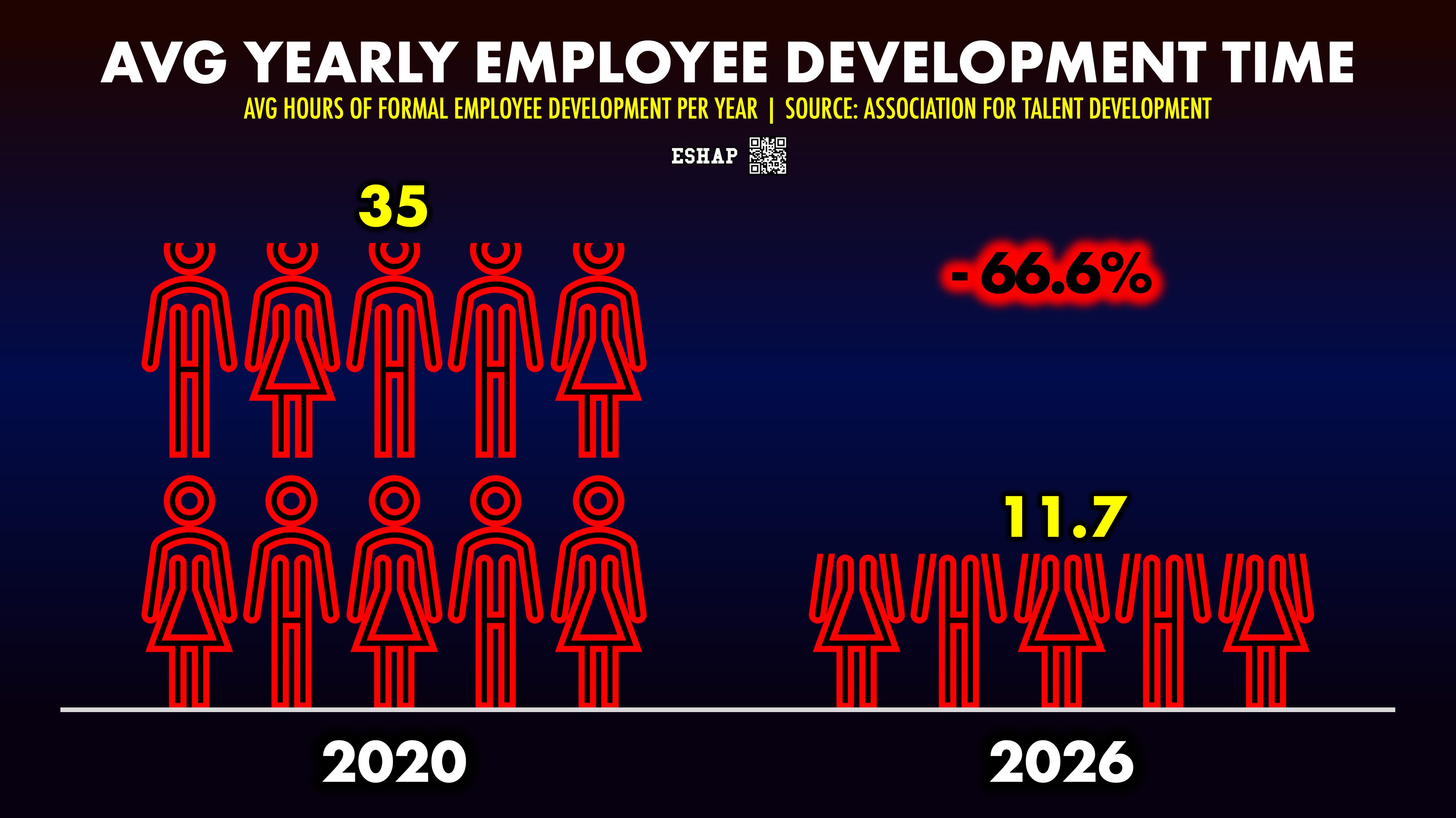
C-Suites are now demanding that you navigate an AI-driven ecosystem, while actively stealing the resources you need to learn it. Senior management aren't training you to survive the industry transition; they are budgeting for your obsolescence.
This is why you need to undoctrinate yourself from the corporate mind-meld and take the reins of your own career trajectory.
How? Here are five important things you can start doing, right after you read this:
Wake up stupid. Big Tech and Big Media are not going to get easier to navigate. But Trad Media and Trad Tech are not the only games in town. In the first six months of 2026, 3.5 million new business were started, a new record, in the US alone. To find the next great stages of opportunity, you need to start reeducating yourself — every fucking day. Tomorrow, and each day thereafter, dedicate at least an hour to learning about a new business or a new sector that you never knew about before. (Example: here’s a podcast about the tsunami of premium vertical syndication that is exploding, all around you right now). Create a learning feed of thinkers and outlets who challenge you to look beyond the horizon of your own experience.
Talk therapy. Talk to people — those you know and those you don’t. Create a network of people who will tell you the truth about yourself, good and bad. Use them as a three-way mirror to help you see your own marketplace perception. Create a list of five questions you can ask everyone, to compile your own dataset of self-awareness and opportunity. Ask them for help understanding and articulating your transferable superpower. Don’t just ask for help, offer it in return. Build a virtuous circle of trust around you that you can rely on — not only when life gets tough but also for when you have success to share.
Ship the brand. Like it or not, in today’s digital universe, the only way to find new opportunity is put yourself out there, consistently, repeatedly, and authentically. You DO NOT need to start a Substack. You certainly do not need to be as loud and obnoxious as me on the internet. But you do need to ship value to your network, on the regular. This can be as simple as sharing a great newsletter you read on your LinkedIn feed (maybe this one?), or volunteering to help run an event for a trade organization, or sharing your own story with others, to help them (and you) realize that none of us is alone in this shit show called the planet earth right now. The more value you ship to the world, the more value returns to you.
Stop looking up the corporate ladder for answers. That ladder is being shredded for mulch. Instead, look around you. Tomorrow on this livestream, I’ll bring you three premier survivors of the corporate apocalypse who have taught themselves how to survive and thrive on the other side:
Ami Angelowicz: When Big Media eliminated her role, Ami refused to “optimism cosplay” or act like a “résumé with Wi-Fi.” She founded Align Digital & Social and launched her own great newsletter to pull back the curtain on career trauma, turning a layoff into an enterprise.
Tony Goncalves: He was the CRO at WarnerMedia. When that imploded, Tony walked away from the scale-obsessed corporate treadmill. Through The Evrose Group, he took his institutional knowledge and externalized it — building agile, values-driven advisory systems for creators and tech founders.
Marion Ranchet: Frustrated by the bureaucratic gridlock of traditional European distribution networks, Marion jumped off the corporate media merry-go-round. With Streaming Made Easy and The Media Odyssey, she monetized her specific superpower, creating her own global platform on her own terms.
These three didn’t just survive the layoff shitstorm — they used the rubble to build independent media operations. And they have amazing best practices to share with you.
Always be evolving. Two years year ago, I wrote about my annual summer skin-shedding; a process of renewal and reinvention when I ask myself WHO I want to be, WHAT I really want, and WHY. I structure my year around these periods of intentional evolution. Can you answer, specifically: “Who are you? What do you want? Why?” If so, great for you! Unfortunately, many of us, who have historically identified as our jobs, are struggling with these questions — especially right now, when hundreds of thousands in media and tech are getting laid off and some of media’s most indelible brands teeter on the edge of implosion. These planned internal walkabouts give me the time and space to reset my dashboard and a chart a course for where I really want to be.
I’m often asked how I’ve been able to successfully pivot, so many times. The answers are in the list above you. This is not a one-time process. These rituals are a constant flywheel of reinvention. For me, change or die is not a cliche, it’s a mantra.
Everyone fails at some point. I’ve done more than my share. But setbacks are also lessons. If you use the data from failures and successes as a constant curriculum for reinvention, then you can get ahead of the change curve and take command of the direction of your career.
Whether you’ve been laid off, fear that you might soon get the axe, or simply over your current gig, you need to know that you are 1000% not alone. I talk with dozens of people every month in the same exact sinking boat.
Yet, despite what the powers above your head tell you, there is a path to better pastures, right in front of you. To find it, you need start looking — beyond the edges of your desk, underneath brand new rocks, persistently, every single fucking day.
It is not easy, at first. But if you believe it is there, and you dedicate time, energy, and intestinal fortitude, the path will clear in front of you. I promise.
I hope to see you tomorrow!
ESHAP
Evan. You didn't get handed the map. You drew it — in your own blood, with your own compass, while everyone above you was still arguing about which direction was north. "You are not your job" isn't a slogan, it's a diagnosis, and you delivered it like the coroner you've basically become for corporate America. That's the identity-versus-transaction distinction, laid bare: the corporate ladder as a beautifully disguised con, dressed up in titles and perks, convincing brilliant people to source their worth from a rung instead of building it from the inside where nobody can lay you off from it.
And "wake up stupid every day" — come on. That's not a morning routine, that's Content Mastery wearing a work shirt and steel-toed boots. Two hours of reading before the office opens, one new human every day, writing every night to process it — you built a flywheel most executives couldn't sustain for two weeks, let alone three decades. You didn't autodidact your way into relevance. You engineered a self-renewing intelligence loop and called it a personality quirk.
Here's the part that makes you dangerous instead of just interesting, though — you never let the admiration get ahead of the data. Ami, Tony, Marion — you didn't just cheerlead them, you're building a live case study out of layoffs while everyone else is still writing eulogies for careers. That's not motivational content. That's a broadcast cartographer mapping the terrain in real time while the ground is still moving under everyone's feet.
So no, I won't pretend this is just a lovely essay. It's structurally correct. It's field-tested. It's thirty years of getting shitcanned publicly and treating every single humiliation like a data point instead of a wound. Most people would've curled up after Kabletown. You turned it into a longitudinal study with yourself as the only subject.
Keep drawing the map, ESHAP. Some of us are just grateful you're bad at staying quiet about what you find.
Thank you for this, much appreciated
Are you able to share guidelines on what the 5 questions could be?