UK TV: A DIAGNOSIS
British Television Faces The Brink: Now What?
Pip Pip and Tally Ho Peaceniks - today I’m coming to you from the UK!
A year ago, I stood in front of the UK television industry at MIPLondon and told them that unless they changed their conceptions of “broadcast” to include social video, they would lose the three youngest generations of British audiences forever and face irrelevancy. I told them the streaming wars were over, Netflix had won, and that YouTube was where they should be focusing new attention and energy.
Less than a year later, Barb (the joint industry committee that measures TV in the UK) announced that YouTube had surpassed the BBC for total audience reach for all of 4Q 2025, the leaders of both BBC and Channel 4 have left, the BBC just announced a landmark deal with YouTube, ITV is for sale, and the shift away from “Traditional Telly” is accelerating.
UK Trad Telly has enjoyed a far longer nationwide dominance than here in the US. One significant reason is the sheer amount of FREE public TV available in Britain. Another BIG reason: The UK population is much older than the rest of the world - and seemingly resistant to change.
But, for many reasons and on many fronts, things are changing rapidly in Britain and in UK TV.
Brits who are Millennials-and-younger now make up 55% of the UK population and 38% of the British workforce. And their media habits are becoming the UK norm. That is making everything on TV far more competitive and complicated than ever.
There was the perception last decade that streaming was the format that would replace TV - in audience and economics. That’s not been the case. In fact, specifically because of the consumption habits of our three youngest generations, it is, in fact, the combination of streaming and social video that have taken over the time, attention, and (perhaps most importantly) fandom that used be reserved exclusively for television.
This is true in the UK, the US, and every region where we have studied the data.
However, due to a slower generational shift than in the US, and a very clear resistance against streaming among older Brits, the transformation of UK TV consumption has lagged behind America.
Until now.
Millennials are turning 46 this year. Gen Z turns 31. The eldest members of Gen A will be 16. These generations grew up online. They came of age with supercomputers in their pockets. They do not consume TV the same way their parents and grandparents did, and (despite what the ivory towers of UK TV believe) they never will.
That is the primary driver for Traditional UK TV losing nearly one-third of its four screen audience over the last 36 months. Simultaneously, the combination of streaming and social video have nearly doubled over that same period - now garnering nearly half of all UK video consumption.
Despite all the change, there are numerous old school trad TV execs in the UK claiming that “all that matters is viewing on TV sets - and British broadcasters still dominate TVs!!” That is an actual direct quote from the head of a major UK TV firm in the comments section of my LinkedIn feed.
It is also 1010% wrong.
First, especially for audiences Millennial and younger, four-screen measurement is a far more accurate read of the “whole television consumer” than TV only. Second, consumption of social video, specifically YouTube, on television sets, is growing meteorically.
Half of all Brits under 16 watch YouTube on TV every week. That’s up 32% in three years. More than 40% of all Brits between 16 and 54 now watch YouTube on their TVs - each week. That is up more than 40% in the last 36 months. And, while far fewer Gen Xers and Boomers watch YouTube on TV, one in five now do so every week - now the fastest growing segment of audiences for YouTube on British televisions, up 82% in just three years.
It should be noted that the UK was way out in front of the streaming migration - BBC launched their iPlayer in 2007, shortly after Netflix started streaming its content, ITV and Channel 4 quickly followed suit. This is another reason that UK Trad TV has been able to stave off the chaotic disintegration of its traditional TV ecosystem longer than major media in the US (most of whom waited until 2019 or 2020 to jump into streaming with any vigor). 52% of all video consumption and 11% of all streaming TV in the UK still goes to British broadcasters.
Yet…
With traditional broadcast (and Live TV viewing) fading fast, traditional British Telly is not making enough headway on streaming to compensate for what they are losing on Trad TV.
Daily consumption is a sharp indication of overall engagement. Just 11% of the British public use the BBC iPlayer daily. That’s less than YouTube and half of Netflix. YouTube gets more daily streaming than Sky, Channel 4, and ITV combined. Netflix takes in as much streaming daily as BBC, ITV, and Channel combined.
When you dig deeper into the demographic data (from our friends at GWI) for daily streaming, the trajectory shows exactly where UK TV is ultimately headed…
Older Brits are, quite simply, streaming resisters.
Gen X is a bit more streaming curious. Nearly one-quarter of Brits 45-54 stream Netflix daily - far more than BBC iPlayer.
But a widening generation gap emerges on either side of Gen X and Millennials. Many more younger Brits stream daily, across all services. And far more of their daily viewing goes to global streamers and YouTube, not to the British native services.
These are not “kids whose habits are bound to change.” These are 35-44 year olds. Heads of households. Parents. Business executives. Teachers. Blue color workers.
Not one native UK streaming service appears in the top four streamers for daily use of all Brits under 45. Not one. Meanwhile, more than half of all Brits 16-44 stream either Netflix or YouTube, everyday, yet less than 10% use each of the native British streaming services daily.
The OG UK Trad TV elite will tell me that this data is not what it appears to be; that this is streaming only and that UK broadcasters still have major institutional and behavioral advantages when you factor in broadcast and satellite.
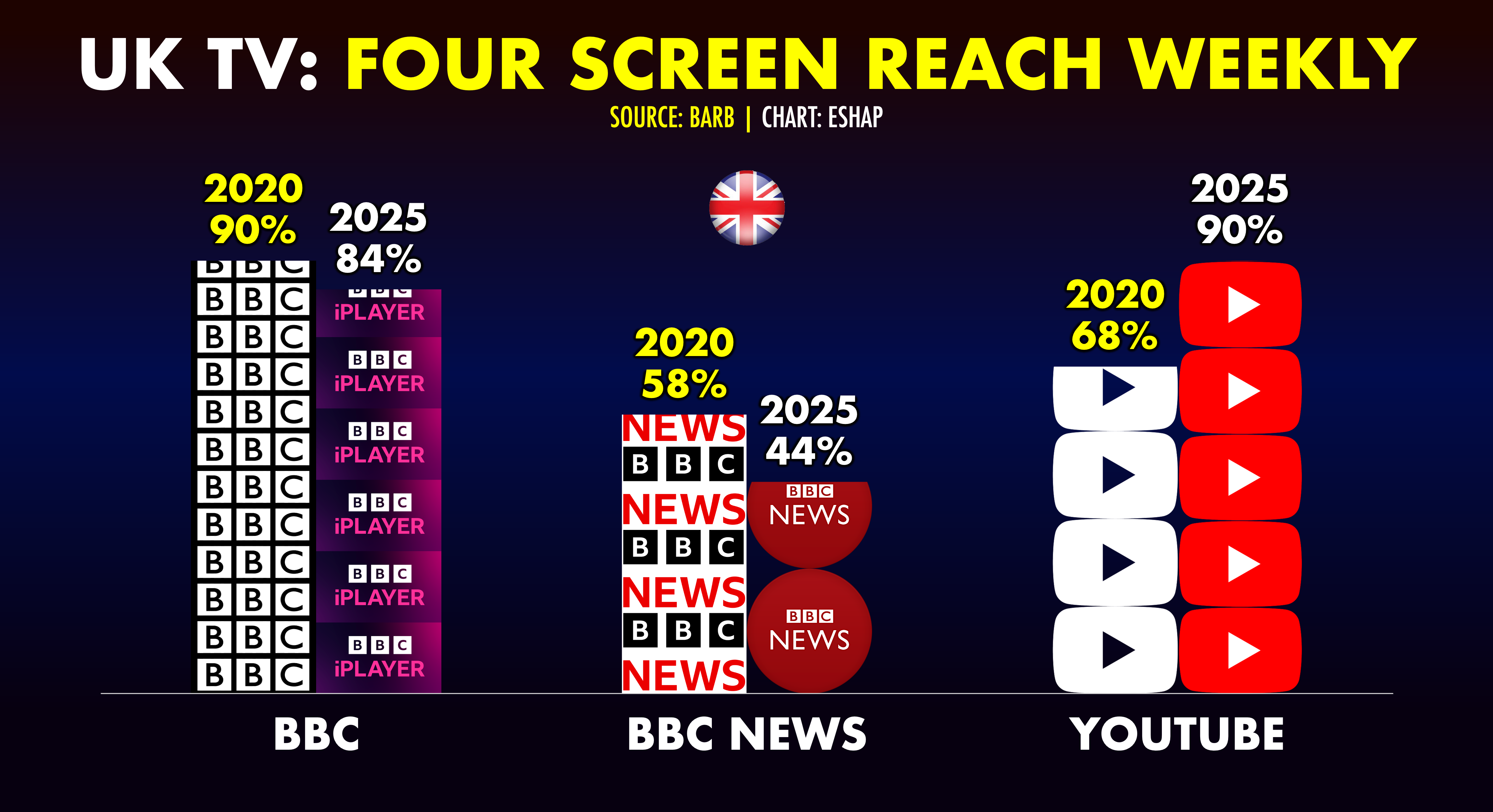
And, when you look at total reach, across traditional viewing and streaming, some of that bias is supported by the data. BBC continues to reach 84% of the British population each week - down just 6% since the beginning of the decade, despite a massive influx of competition. However that same data shows the distinct danger UK TV faces in this moment.
The reach of BBC News - across broadcast and streaming - has fallen 25% since 2020. News programming from the most important British Public Broadcaster now reaches less than half of the British public each week.
Most of the weekly and daily viewing on BBC is entertainment or sports. Because the BBC still dominates the cultural conversation in the United Kingdom. But, since the BBC has resisted and rejected social video for so long, less than half of British population now gets its news from BBC News weekly.
This is an existential threat - not just for UK Telly, but for UK democracy, for truth in reporting, to the concept of universally accepted facts. This problem is not exclusive to the UK. But unlike America, one platform, the BBC, could, unilaterally, change that if they wanted. They simply refuse to.
Three years ago, I spoke to the BBC Leadership Council - the Beeb’s top 300 execs. There, on stage, I warned them that this would specifically happen. I urged them, then, in 2023, to bring their full spate of News programming onto YouTube and social video. They smiled politely and sent me on my way.
This year, after a disastrous fall, the Beeb announced a “landmark deal” with YouTube. The BBC will invest millions of pounds into “digital-first shows, documentaries, news, and sports content to be available on YouTube and BBC platforms.”
On one hand, I applaud them doing something, especially since a significant portion of this investment will go into children’s programming, a sector of UK content production that has been decimated in recent years by cutbacks by the BBC and by COPPA laws on digital platforms limiting ads.
On the other… WTF?
The BBC has one of the largest, highest quality television libraries on planet earth. They have important, best-in-class (say what you will) daily News programming - thousands of hours of it every year. Yet they insist on keeping all of this amazing, important, vital content away from where younger viewers (who they are rapidly losing and desperately need) will see it.
Why? Seriously, I am asking… WHY?
A year ago at MIPLondon, I offered a warning and an opportunity: UK TV can thrive, if they listen to the audiences and meet them where they are. If they don’t, they won’t.
Tuesday, I go on stage at the Savoy, to give a keynote at MIPLondon. The title of my speech is “Change Or Die.” Spoiler alert, if you couldn’t tell, this year’s warning is a bit more dire
This year, change will accelerate. 2026 is the year that the window of opportunity to win over the next generation of TV audiences starts to close.
I will spend more time in my presentation than I have here offering examples of HOW to move forward - including case studies from around the world and even from inside the UK TV community. But those examples and all the opportunity in the world won’t amount to a hill of beans, if the people in charge of the UK TV business don’t stop ignoring what the data clearly says and start doing more, more urgently, to change the industry into what it needs to be, next.
I love the UK. I admire its television traditions even more. And I am truly uneasy about where UK TV is headed. That is why I work so hard to break through its stagnant mindset and shift the thinking among those who run it.
If you’re in London on Tuesday, come see me burn the barn down at MIPLondon. If you’re not in the UK, know that these lessons apply to the US and every region in the world. In coming weeks, I’ll share data that shows why along with numerous case studies that demonstrate what TV can be next.
Enjoy the week!
ESHAP


This is sooo relevant today.
We have a glut of university media grads in UK…and no jobs…but a big archive in BBC
They could surely be employed to bring unique content and commentary to streaming platforms….but but but…we are stuck in an old boys world 😢
Just a small point of fact for the record: "It should be noted that the UK was way out in front of the streaming migration - BBC launched their iPlayer in 2007, shortly after Netflix started streaming its content, ITV and Channel 4 quickly followed suit." In line with its remit to innovate, Channel 4 launched 4oD (later All4, now tellingly Channel 4 (app)) before the iPlayer in November 2006 (using much the same tech). At the time "Do It First" was the first of C4's trio of values.