

OpenAI is AOL
What the History of Bubbles Tells Us About Tomorrow

Happy Monday Peaceniks. Today’s case study: Why OpenAI is the AOL of 2026.
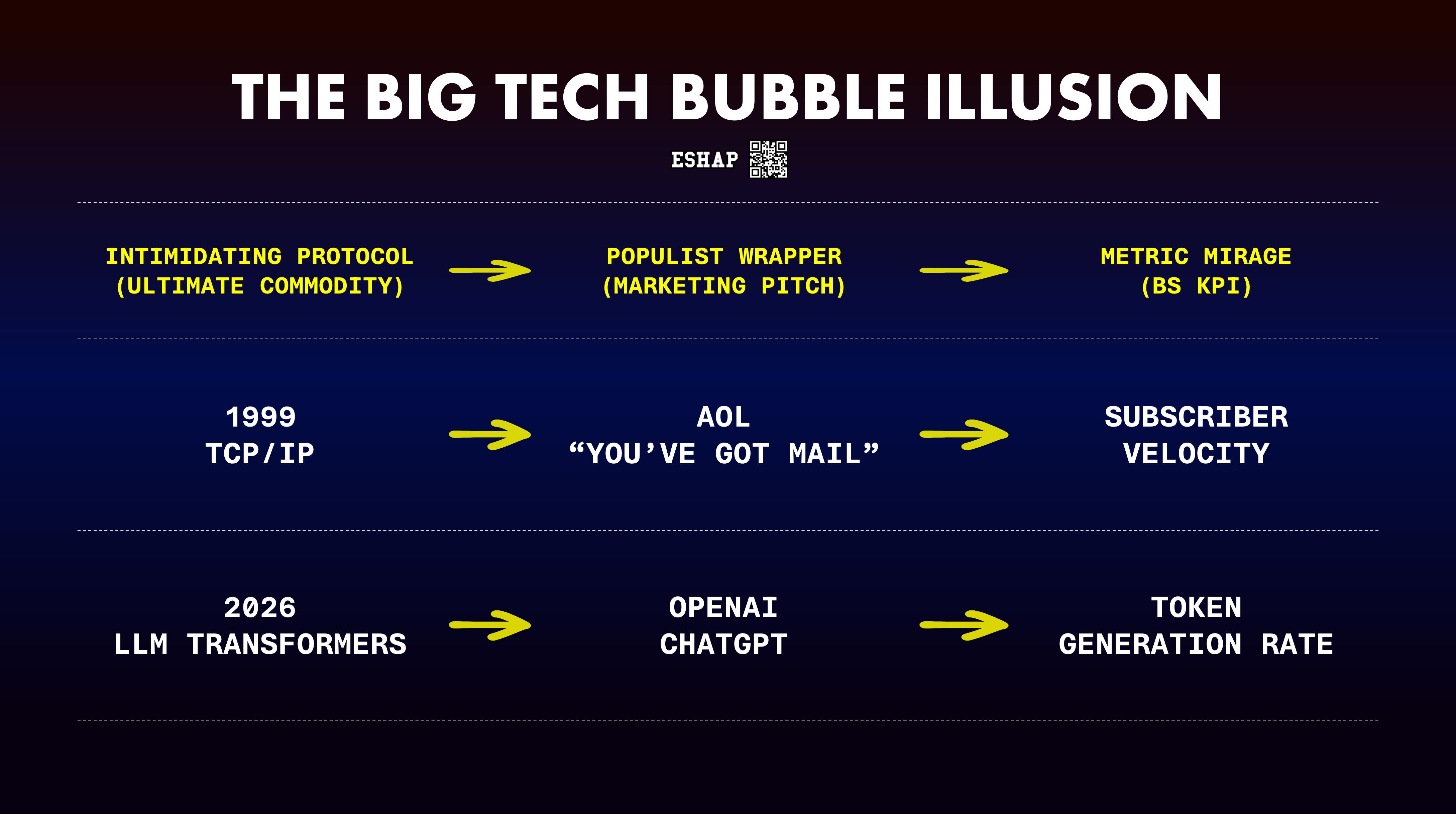
Era-defining economic Bubbles (and bursts) are never caused by random acts of speculation — they are all intentionally inflated. They all start as cultural “phenomena,” invented by “visionaries,” shrouded in “new-age metrics,” and sold to the public by “trusted institutions” as “the next big thing,” until the rug gets pulled and the bottom falls out.
This was the 1720 South Sea Bubble, when a British shipping monopoly with zero ships generated a groundswell in South American commodity trading, nearly taking down the British Empire. This was Enron, when Jeffrey Skilling wrapped volatile energy trading in a shiny “New Economy” bow, which Wall Street sold to investors as “risk-free profit.” In the 2008 Global Financial Crisis, Countrywide put lipstick on complex, toxic, subprime mortgages and called it “the democratization of the American Dream.”
In the Dot-Com Bubble and crash, the designer drug of choice was AOL. In today’s AI hype-Bubble (and impending pop), the sexy gateway drugs are OpenAI and ChatGPT. The eerily parallel stories of AOL and OpenAI prove the dangers of combining a revolutionary tech, zero discernible long-term business model, and a singularly powerful message. A deeper comparison of AOL and the Dot-Com Bubble to OpenAI’s Closed Loop Economy lays bare the underlying fissures in today’s AI models and points toward likely long-term outcomes for the wider AI industry.
CAUTIONARY TALL TALES
For both AOL and OpenAI, the revolutionary nature of their technology was quite real. The problems arose when they convinced themselves and the world that “this single beautiful feature,” could be a standalone, hyper-profitable industry in a new, yet to be invented digital economy.
In both case studies, when the mousetrap beneath the cheese gets exposed, the structural parallels share a corrupt reality. Both companies weaponized circular financing to mask staggering operational deficits, and both locked investors into unsustainable business models based on relatively simple features, doomed to be absorbed, commoditized, and rendered free on the other side of the inevitable (and very predictable) crash.
THE METRIC MIRAGE OF THE GATEWAY DRUG
The genesis of both the Dot-Com and AI Bubbles relied on a three-dimensional psychological con game. The underlying technologies – the TCP/IP internet protocol in the 1990s and transformer-based large language models in the 2020s – were significant paradigm shifts. They were difficult and costly to achieve first and incredibly challenging (though far from impossible) to replicate. Importantly, no one in banking or on Wall Street really understood them. So, the tech pioneers, with a limited scaling window to build an infinite growth curve, invented metrics and manufactured wins to fool investors, so they could secure additional investment and solidify their pole position in this “new economy” they were inventing, with even more imaginary growth.
AOL cracked open the internet by wrapping it in a friendly, walled-garden desktop interface, bombarding the population with physical CDs to creates an immediate consumer monopoly. Wall Street, blinded by the cultural phenomenon and its own greed, abandoned traditional cash-flow analysis. They invented a new gospel of valuation based entirely on subscriber acquisition velocity.
Twenty-seven years later, OpenAI gamed out that same playbook with ChatGPT.
By suddenly dropping a simple, imperfect, sycophantic, hallucinating text-based AI prompt, earlier than all his fellow traveling AI broligarchs and Chinese nemeses (all with very similar blueprints), wrapped in Olympus-like fanfare and God-like promises, Sam Altman and OpenAI achieved the fastest consumer user-base scaling in history and manufactured a market. Learning nothing from previous experiences, and entirely uneducated in the underlying tech, Wall Street tripped over themselves capitulating to the hype, valuing OpenAI not on any historical software margins, but on the made-up metric of token generation rates — entirely disconnected from basic financial grounding.
The fundamental error in both eras was identical: based on Barnumesque promises by charismatic charlatans, the market simply believed. “If a complex new product (that we don’t fully understand) becomes suddenly ubiquitous, it must be inherently valuable as a product and industry – throw money at it!” (Also see: Crypto.)
THE MERRY-GO-ROUND-TRIP
As the initial high of both helium bubbles began to fade into reality, both AOL and OpenAI ran into brutal financial brick walls. Neither company could organically sustain the staggering operational overhead they needed with their real, real-world revenues. AOL faced the massive capital drain of maintaining dial-up modem banks and network infrastructure; OpenAI faced an even more catastrophic cash burn, running up $34 billion in total costs against $13.07 billion in revenue in 2025, driven by relentlessly rocketing computational, infrastructure costs, and contractual obligations. Neither AOL or ChatGPT could possibly generate enough actual revenue to justify their valuation or cover their mushrooming expense. AOL’s fail was historically epic. After years of rainmaking hype dance, OpenAI just postponed their long-anticipated trillion-dollar IPO to avoid pulling back the curtain on the scope of their charade.
Both were first with revolutionary tech. Neither could make the math make a profit. Both hid foundational structural deficits from investors and maintain hyper-inflated valuations. And both AOL and OpenAI resorted to the same financial engineering tactic: round-trip balance sheets.
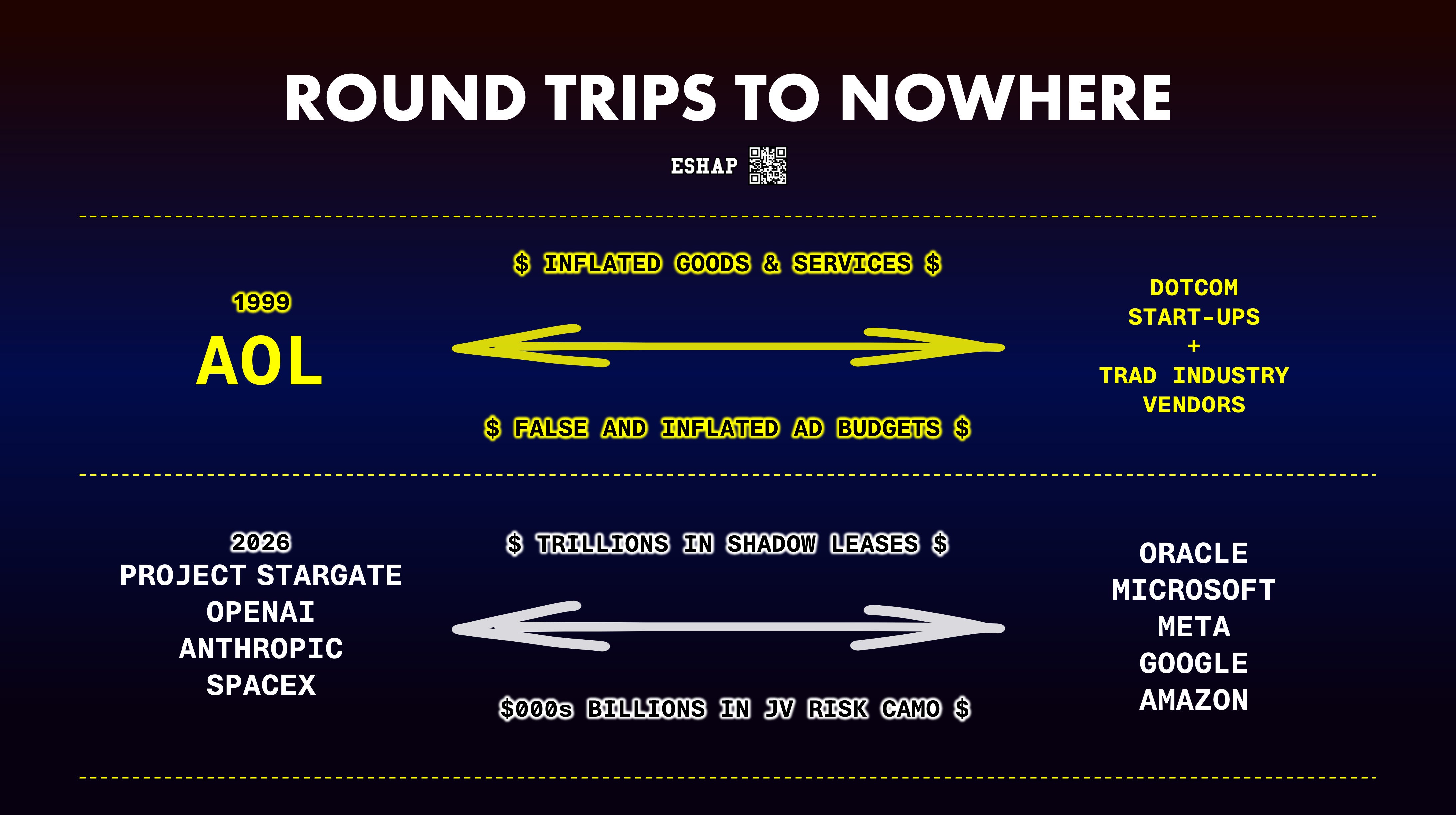
At the heart of both the Dot-Com and AI Bubbles is an identical deception: manufactured revenue from shuffling the same big bag of money around a closed loop of co-conspirators.
To appease Wall Street’s insatiable demand for top-line growth, both AOL in 1999 and today’s 2026 AI coalition transformed their balance sheets into revolving doors. They routed their own investment capital through interested and needy third parties, only to receive it back to book as their own “organic” revenue.
Keep reading with a 7-day free trial
Subscribe to Media War & Peace to keep reading this post and get 7 days of free access to the full post archives.