Microdrama-O-Rama
This Is How Vertical Television Will Be Revolutionized
Happy Monday Peaceniks. Ready to go vertical‽
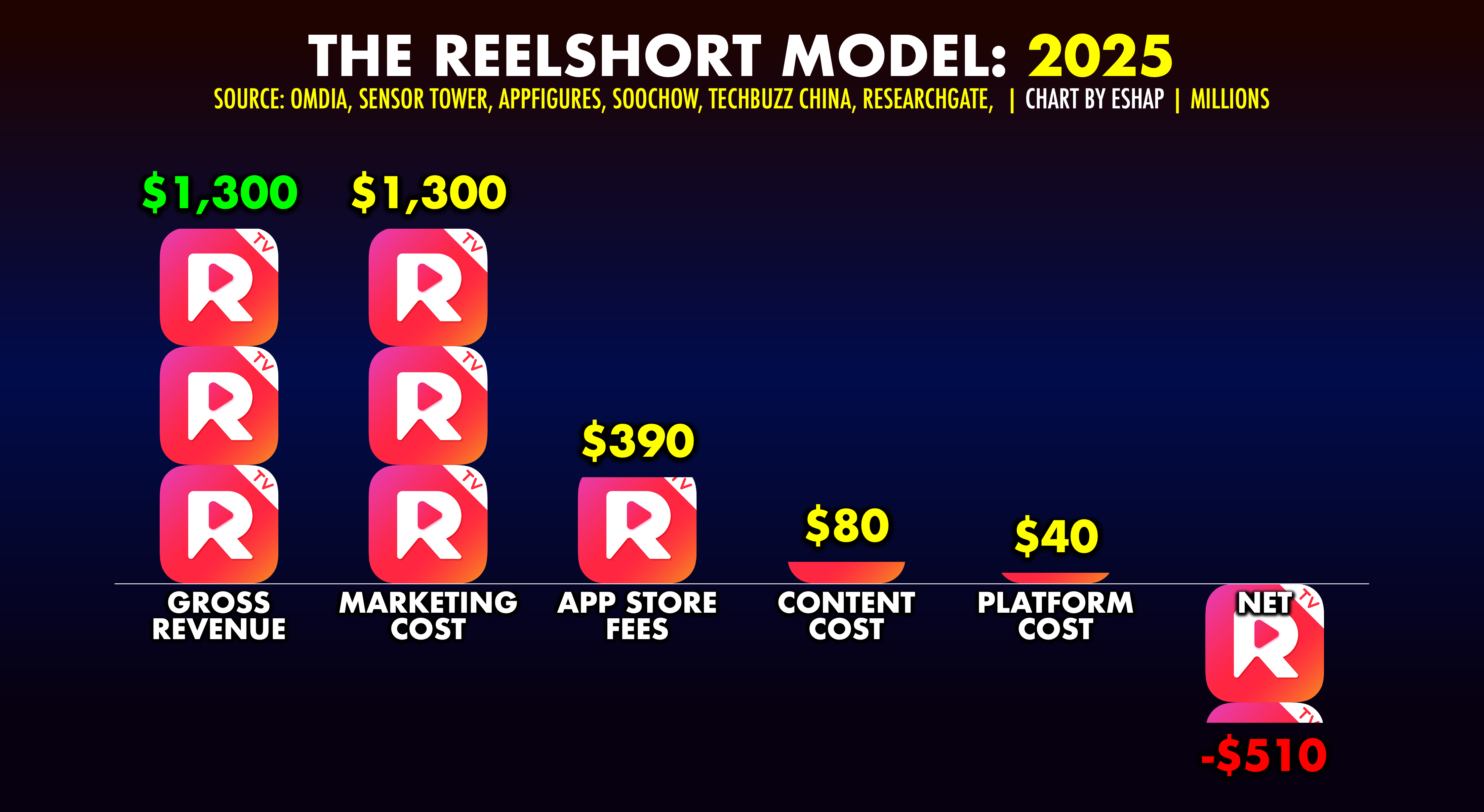
I am vocally on the record calling out the Microdrama business model as “bullshit.” The model that sparked the Microdrama movement is personified by the massive market leader, ReelShort: pay-as-you-go, lootbox storytelling, adapted from gaming apps by those same designers.
My first critique is that the content is crap. My next is that their producers treat artists and crew like livestock. My last issue is that unless you have billions to spend, and/or are backed by the Chinese government, THIS IS NOT A BUSINESS MODEL.
Last year, based on numerous sources, ReelShort generated $1.3 billion in revenue - primarily through in-app sales of pay-more-to-see-more packages. They spent the same amount, $1.3 billion, to acquire the customers needed to generate that revenue. This is not organic growth; this is paid acquisition marketing. Churn is their business. They are a massive spender on social media CPI marketing, at higher and higher CACs. That is why they lost half a billion last year. And this is true of most of the cohort of original Microdrama pioneers - a model primarily designed for the Chinese market.
Why do these companies pursue problematic models? Number one, data collection. These are Chineses companies and many are connected in some way to the Chinese government. Second, massive scale. Everyone wants scale but very few have BILLIONS to BURN to own a market and figure out the model later. That’s how TikTok was made. Bytedance burned BILLIONS before changing Musical.ly into TikTok, and then TENS OF BILLIONS MORE on acquisition marketing and re-marketing, gaming their way to third or fourth place worldwide. In either scenario, this model only works at massive scale, with a captive market, where these two goals can play out in a very controlled, yet unregulated environment.
And this is why I call “bullshit.” There are a lot of investors, studios, production companies, creators, filmmakers, crew, soundstage construction companies, and actors scrambling to be a part of the “Microdrama movement.” Most do not understand the precarious business model propping up the biggest players in the sector. Everyone is lured by the promise of low-cost-scripted content and billions in recurring revenues. But few know about the cost per acquisition of every user and the recurring re-marketing costs to keep the hamster wheel turning.
Even the data we all share about Microdrama economics are inconsistent and shrouded in hyperbole.
If you track purchases made outside the usual app store environments, which are the majority of sales in China, you get one end of the spectrum. If you track only sales made through the two major app stores, you get an entirely different dataset.
That said, there is a tide turning in the vertical video market. New players. New use-cases. Most importantly, new models. With a major shift to un-gated, free, ad-supported models, I think 2026 is the year TV actually goes vertical.
But first, let’s look at WHY…
Millennials turn 45/46 this year. Gen Z turns 30/31. 58% of Americans are Millennials or younger. For the most part, as this data from GWI demonstrates, they entertain themselves very differently than their elders…
Gen Z uses Trad TV three times less than Gen X. Gen X watches social video less than half as much as Gen Z. Where everyone meets in the middle is streaming.
When you look at heavy or occasional use, streaming is the method of video consumption most evenly distributed across the generations.
For years, the conventional wisdom in Media has been that streaming would replace TV. And when you look at pure usage from a format standpoint, that has happened.
But not the way conventional wisdom predicted…
A platform traditionally framed as “social media,” YouTube, is now the number one television channel and streaming platform in the US. The interesting irony? That that top TV channel actually houses millions of channels from publishers, social media stars, and the general population alike.
In the UK, YouTube, that “social media” channel, topped the BBC for total reach for all of 4Q 2025.
Meanwhile, in the ad market…
Streaming and TV are getting their asses kicked by social media all over the world. Last year, Meta sold more advertising, alone, than all TV on Earth. In 2026, more than 50% of all ad dollars in the world will be spent on Meta and Google - that share jumps over 60% when you include Amazon and TikTok.
Unlike much of traditional Media, social platforms crush it with small and medium sized businesses who normally do not buy TV. They are also the largest ad platforms for P&G and Unilever, who increasingly buy direct from those platforms.
This decade, between time and revenue, streaming has not come close to replacing what television has lost. With consumers under 45, this century, television as a whole (streaming plus Trad TV) has lost at least 50% share of voice, nearly all of it to social media.
Millennials are reaching middle age while Gen Z are becoming our managers, teachers, cops, and business owners. As they do, their behaviors become our societal norms.
TV is not being replaced by streaming, it’s being being replaced by the combination of streaming and social video.
As I said during my Keynote at RealScreen, streaming and social video are not so much competing as merging. You see this everywhere you look. MrBeast on Amazon and Paramount (Survivor Season 50), Ms. Rachel on Netflix. BBC and YouTube hooking up!
Heading in the other direction, Instagram and TikTok are coming to TVs everywhere, this year.
Amidst all of this, major brands are moving major money to social.
But beyond Influencer campaigns, directly inspired by the Microdrama Movement, numerous brands and agencies are transforming traditional TV branded marketing into premium social video. Unlike the ReelShort cohort, where bad content is unlocked by paying fees, this higher end (IMO) content is free on social video platforms.
P&G - who literally gave Soap Operas their name - is now producing 50 episodes of a micro soap with Dentsu; and distributing this new-era TV show directly on Instagram and TikTok. A Vertical Soap Opera. This is was the first of many indicators pointing towards a vertical television revolution this year, one that goes far beyond Microdramas and their model.
Last year, BILT produced an original Vertical Comedy, Roomies. They made ten episodes, distributed across TikTok and Instagram. BILT just greenlit season 2.
In December, JC Penny and Univision partnered for a holiday microdrama - a Vertical Telenovela - again brokered by Dentsu, that ran across JC Penny and Univision’s TikTok and Instagram channels.
And Rob Wade at Fox may just have given us the perfect case study of merging streaming and social into Vertical TV with their investment in microdrama wunderkinds Holywater and a three-way output deal with Dhar Mann Studios.
While Insta and TikTok are invading TVs, to counterattack social video time, and attract social video ads, premium streaming platforms are all now going vertical as hell!
But perhaps the best example of Vertical Television’s full potential came from a very unexpected source.
Imagine the massive libraries of Disney, WBD, Paramount, BBC, ZDF, and other legendary publishers finding new audiences for existing content, generating new revenues from sunk costs, on mobile phones everywhere. Imagine if Disney had packaged that High School Musical stunt with P&G! Imagine! High School Musical is now 20 YEARS OLD!
I still think ReelShort and their lookalike Microdrama models are full of shit. They are treating talent like trash and they are fooling a lot of people into chasing fool’s gold. It is also very limited thinking, down to the genre’s name. YET…
Over the next five years, one of the biggest movements in Media will be the crosswinds from major Creator brands moving to Trad TV and major mainstream studios moving into Creator formats. The merger of streaming and social video will create a market for Vertical TV: Premium entertainment in a social video format.
Everyone is converging on it right now. Not everyone knows why or how. As with social video and streaming, it will not be an easy business to make work. Like both, advertising will be a major, if not majority, funding force.
Going into the NewFronts and Upfronts, many brands are looking for “microdrama” opportunities. Going into this spring, the premium platforms are seeking vertical content. The Microdrama movement is changing the business. Just not the way everyone thought.
Trad TV is being replaced by the combination of streaming and social video. The producers and platforms who create and distribute their IP, simultaneously, on TV and social video, will succeed. Those who can’t, won’t.
Have a great week!
ESHAP


Great take. I highlited recently in one of my substack that short vertical “dramas” “comedy” “docs” can save broadcasters and their IPs. Do you think long form content is not getting along anymore with new gens?
umoshiroi ! once again, facts, numbers and the white hat of facts from master Evan
will be saving the day and the night too ! thanks for the ultra laser focused article...
'micro-o-rama' article will be most useful reference for our micro-ultra-dense-drama
we are about to produce from Rio !
how would you deal w the 'quantum physics' of comenting and observing changing
behaviour ? but the real question is, would you also add some geographical data
to be a third dimension - as you may know, soap-opera is a latin america invention
awhile the numbers from south sunny tropics may not be painted with kanjii figures
emotional upgrading seems the future trend of human narratives.
cuttin long dramas in micro-shards is good for the speed, but some pleasures
are better in the long flow.
audiencemaking ettema 1994 is the sage book to re read !
https://youtu.be/9rP4PEOS9yk?si=0wfSkdGjsNCZzjQa
cheers from the beach...!