

CANNES LIONS: LIE ON
Cannes Lions Shows How The Ad Business Lies To Itself

Happy Monday, Peaceniks. I’m just back from Cannes Lions, and I’m here to report that the rosé was cold, the yachts were wet, and the cognitive dissonance was beyond deafening.
FULL DISCLOSURE: I go to Cannes Lions every year because, in short, it’s my job. I make money at Lions for appearing, moderating, predicting, and pontificating — to bring data and deliver inconvenient truth. My expenses are covered. It would not otherwise, for me, in any way, be worth the enormous time and expense it requires to attend the epic boondoggle we call “the International Festival of Creativity.”
EVEN MORE FULL DISCLOSURE: I enjoy Cannes Lions. I stick to the places where I’m invited, and avoid big, crowded parties. There are few events with the varied and interesting cross-section of thinkers and doers who attend Lions. This year was no exception. There is significant value exchanged at Lions — but, as I demonstrate below, it is just not tied in any way to the silly way all the money gets spent.
COLD HARD FACT: Cannes Lions personifies perfectly the ad industry’s absolute inability to face its own truth. From that point of view, Cannes 2026 was this on steroids.
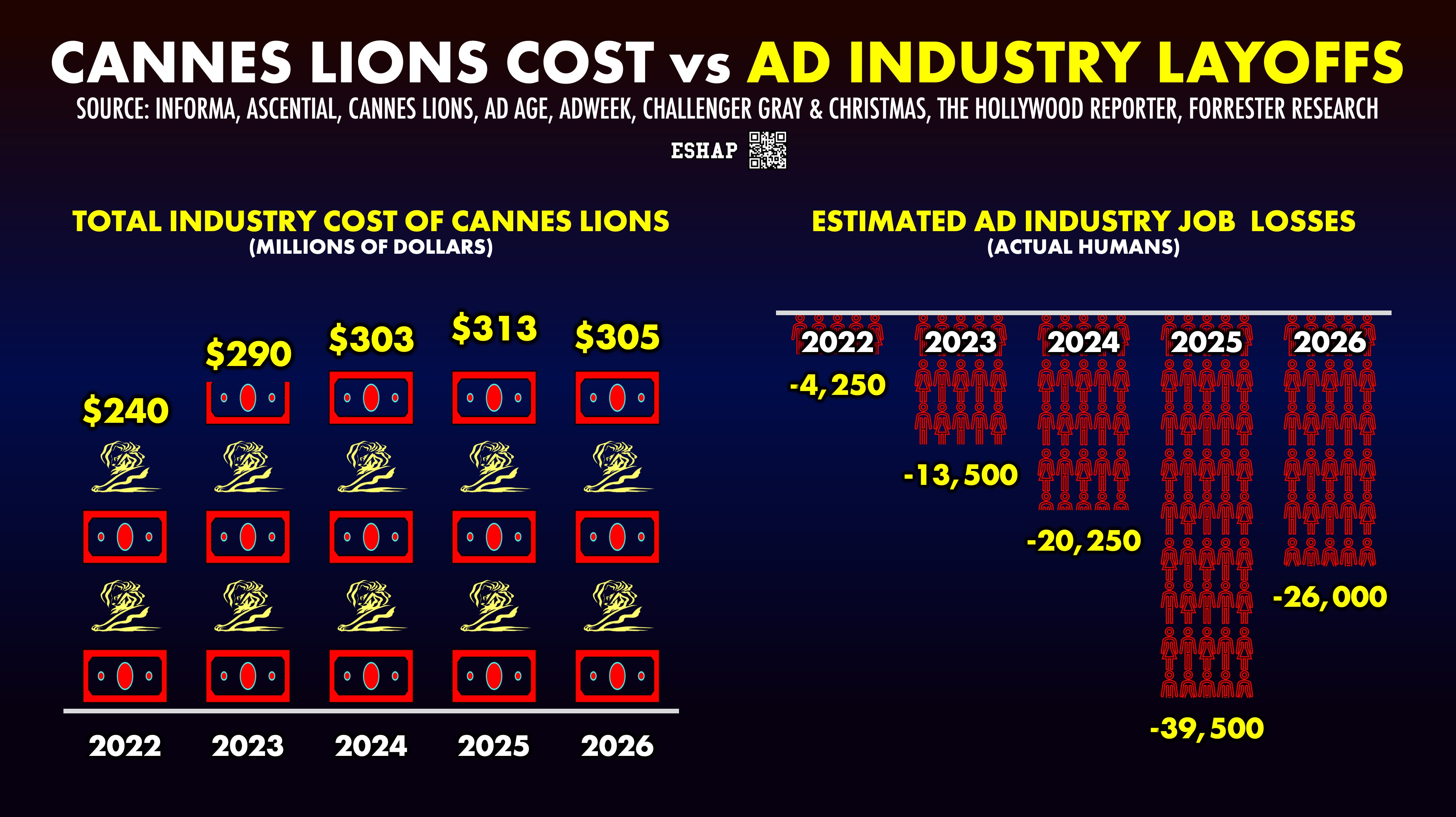
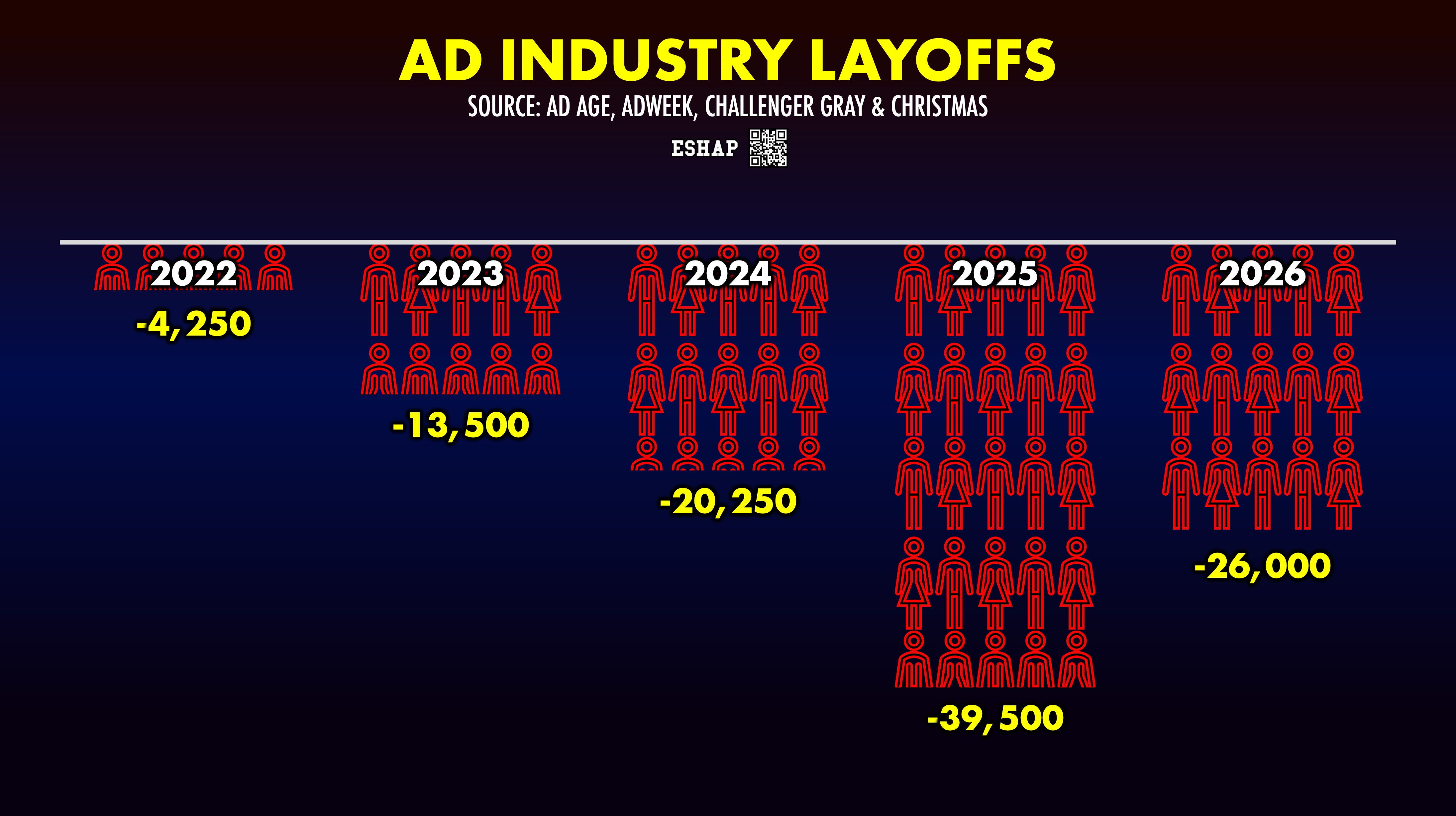
The marketing sector is going through its greatest disruption of the HoldCo era. The advertising industry has lost 100,000 jobs since 2023. Consolidation, automation, fragmentation, and the great big tech-ification of the marketing economy have left the ad industrial complex reeling. Every conversation on the Croisette this year was cast under the dueling shadows of AI job replacement and consolidated irrelevance.
Yet, in 2026, buyers, sellers, agencies, platforms, and brands spent $305 million constructing and enjoying Cannes Lions. In just the last five years, we have spent more than $1.3 billion on Cannes Lions.
Imagine how much we could improve our collective measurement with a $305 million investment. Think about how many entry-level or mid-manager jobs we could retrain and redeploy with that chunk of change (1505 jobs at $135,000 each in fact). Consider how much training those funds could provide, to students from underserved communities who never otherwise would be granted entry into the ad industry (thousands). Or, if you’re into dystopia, think about how much less “uncanny valley” we could make our AI advertising with $1.3 billion over the next five years.
The astronomical 2026 figure was actually down $8 million from last year. Industry consolidation is slightly to blame for this small retreat. But the single biggest reason behind the spending drop at Cannes Lions epitomizes everything that’s wrong with the ad business:
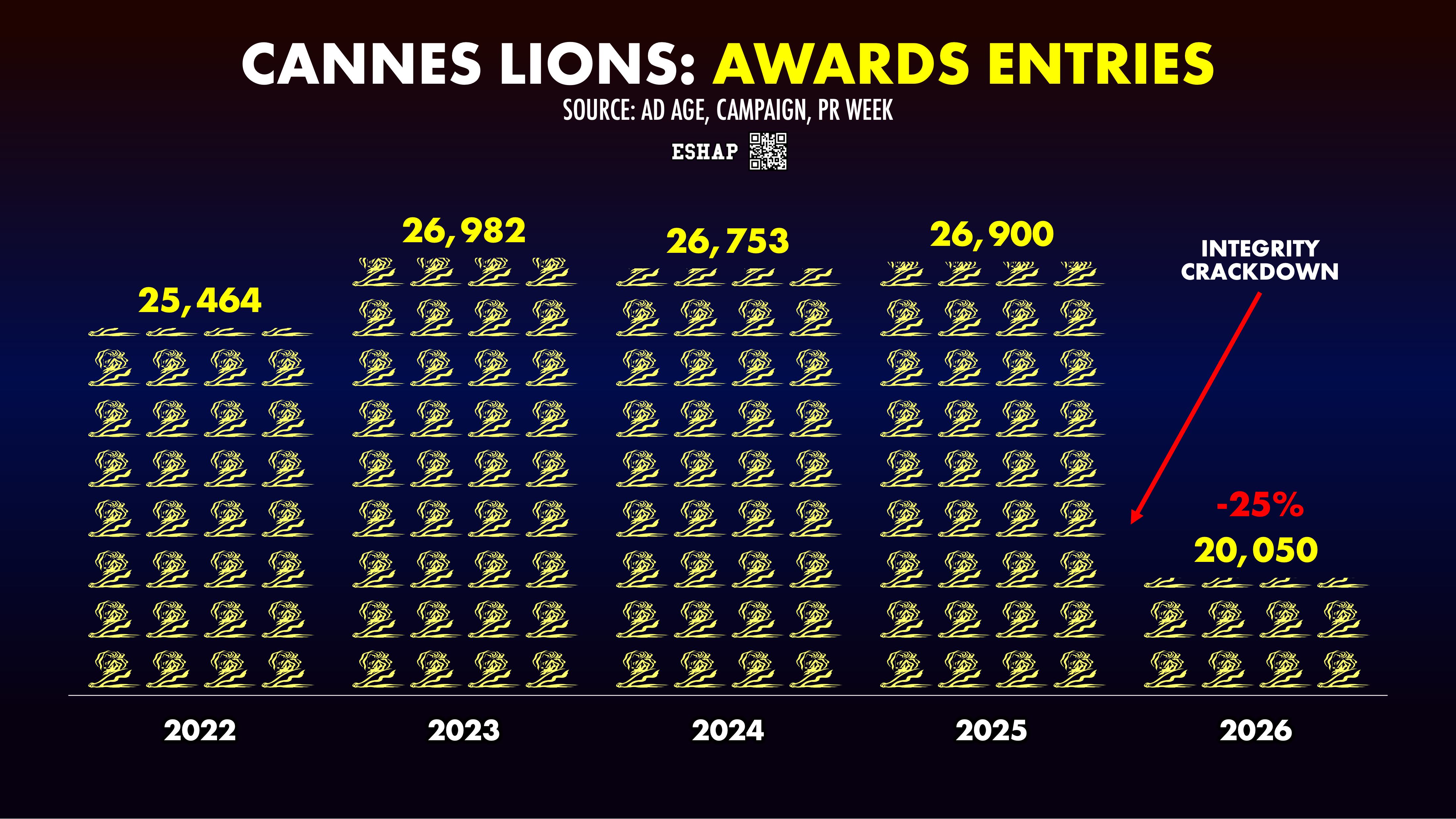
Cannes Lions participants spent $6 million less on their awards entries in 2026, because so many of them were caught cheating on their entries in 2025.
The central defense of the Cannes ecosystem has always been: “Yes, the beaches are expensive, but it’s all in service of celebrating the highest tier of verified global creativity.”
Except that it’s really not.
Last year, twelve Lions winners were forced to return their trophies when an investigation exposed that an Omnicom-owned agency had aggressively weaponized generative AI to completely fabricate the real-world impact of its work. Once the specific awards entry fraud was exposed, a domino effect rippled through the ad industry. Agencies around the world were dragged into parallel investigations for unverified sales figures and entering high-profile case studies without sign-off from their clients.
Beyond resignations, this controversy ushered in new Integrity Standards for Cannes Lions entries, with dual-layer fact-checking, declarations of factual accuracy, integrity audits, and multi-track authorship authentication. As a result, submissions to Cannes Lions are down more than 25% year on year.
This spending and submissions cut is not due to inflation, austerity, or consolidation. The data demonstrates clearly that collectively the ad industry held back one in four submissions because they could not meet their own honesty requirements.
Meanwhile, while awards submissions declined and festival passes flattened, the madcap party on the beach much more than raged on.
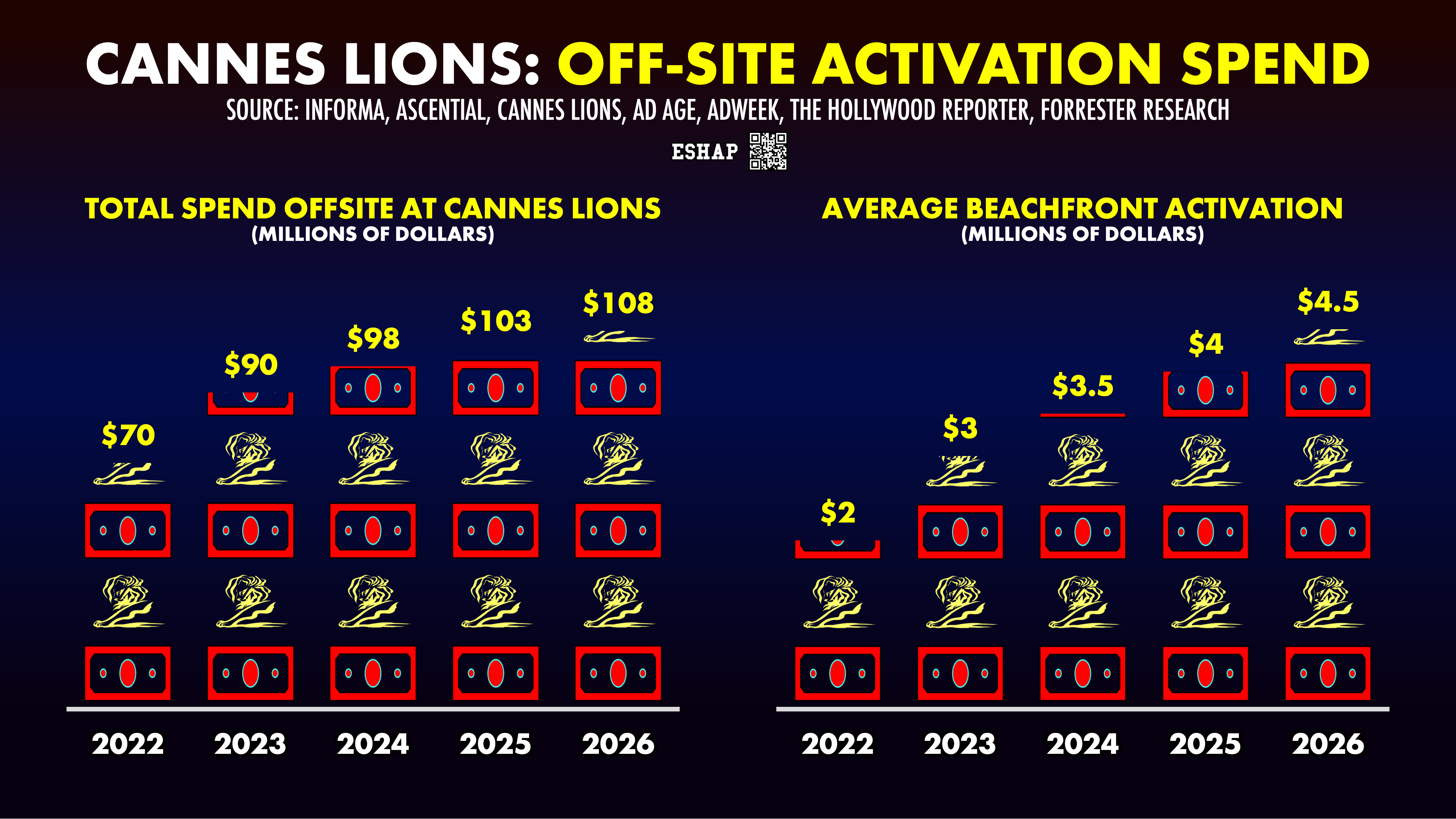
The total investment in those spectacular, yet temporary, party palaces along the Croisette reached $108 million this year. The average activation on the Croisette in Cannes in 2026 was $4.5 million. Omnicom – smack in the middle of dissolving three legendary agencies and laying off four thousand employees – spent upwards of $3 million on their beachfront Cannes Lions activation this year.
We have officially entered the Jazz Age of advertising.
The industry is dancing the Charleston on a billion-dollar beachfront, popping champagne on yachts, driving up real-estate asset bubbles, seemingly completely oblivious to the structural cracks in its floorboards.
In the 1980s, holding companies disrupted the business via financial roll-ups. In the 1990s, they unbundled media from creative to charge clients twice. But in 2026, the HoldCos have officially run out of parts to spin off and companies to roll up. This is the era of the Quiet Liquidation.
To absorb the cost of enterprise AI and survive declining market shares, HoldCos are using the operational noise of mega-mergers to retire iconic agency brands like DDB, FCB, and MullenLowe, folding historic names into centralized, amorphous blobs.
The foundational math of the HoldCo model was always a labor arbitrage engine: hire thousands of low-paid junior staffers, bill clients a massive premium for their time, and pocket the margin. But according to the Basis 2026 Advertising Agency Report, a staggering 87% of agency professionals — 92% of senior leaders — now believe that the traditional agency model is entirely broken and unsustainable.
During a recent investor day, Omnicom CEO John Wren admitted that 58% of their corporate revenue now comes purely from automated media transactions, while creative services have shrunk to just 18%. His exact quote is the ultimate indictment of the current global agency regime era: “In the environment we operate in, Creativity is perishable.”
If that’s the case, John, then what value does Omnicom actually add? What is the case for the ad industry’s billion-dollar Festival of Creativity?
This question is particularly urgent, given the ample proof that all this new “artificial creative-productivity” uncorked by agency AI is actually viewed as toxic waste by the very consumers it targets.
Last week, at Cannes Lions, The Harris Poll released new data showing that the large majority of consumers think that “AI makes brands seem cringy.”
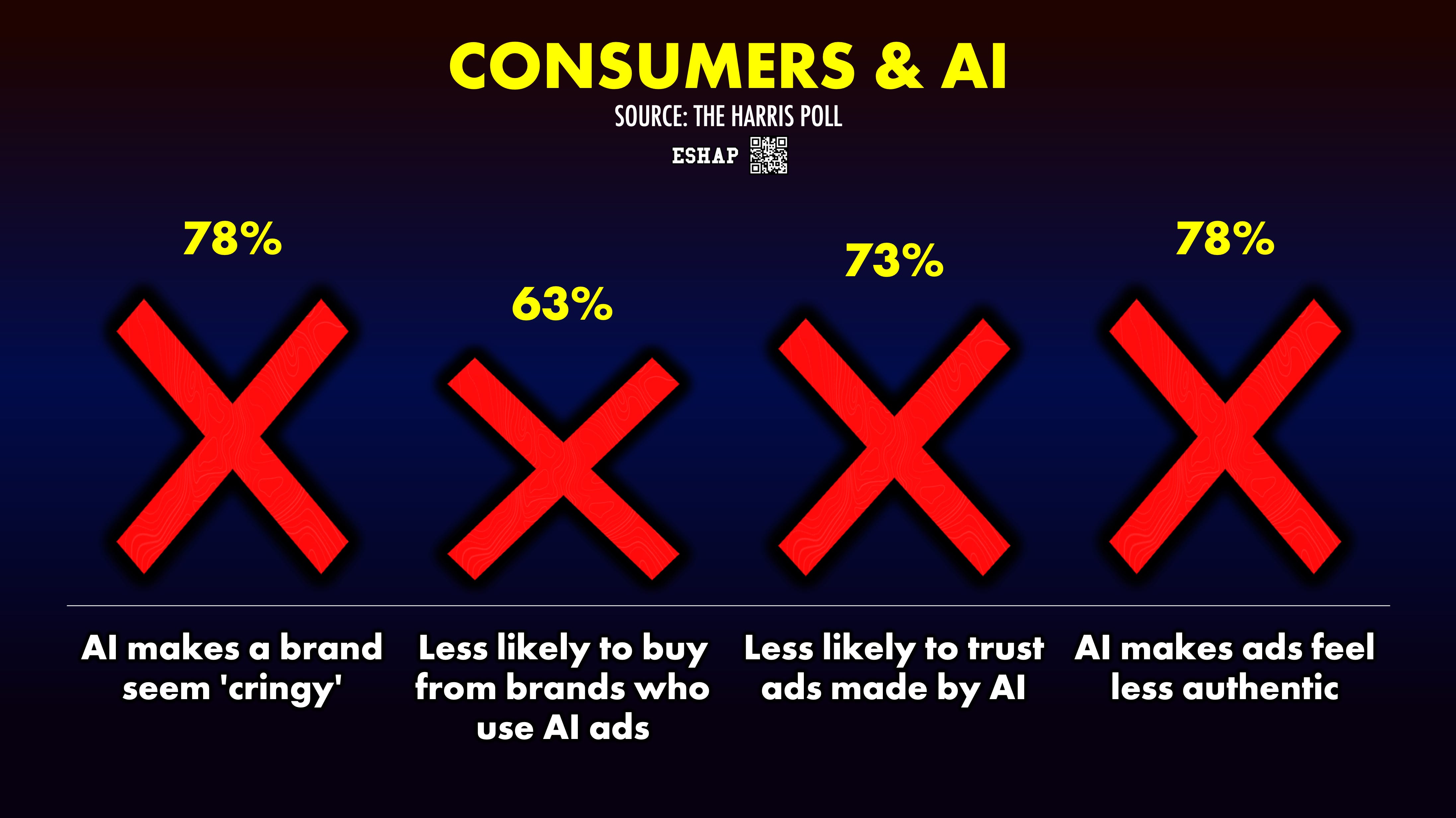
Despite inflation, travel costs, and consolidation, attendance at Cannes Lions 2026 was actually flat year over year at approximately 13,000. However, this represented a substantial attendee share shift: HoldCos cut back on travel, while tech firms and C-suites bulked up on the beaches. And the newest, most-celebrated demographic on the Croisette this year was: Creators.
Independent creators and influencer network execs swarmed the French Riviera, with nearly everyone declaring that Cannes has officially become “creator town.” Over 500 top-tier digital creators flooded the festival — up significantly from last year — effectively relegating legacy agencies to NPCs at their own event.
But here’s the inconvenient truth about this new Cannes-Creator love-fest: to the ravenous advertising industry, Creators are ONLY a new shiny toy.
The ad biz has not suddenly “fallen in love” with decentralized human creativity. It has merely discovered a new, unlimited, highly efficient (aka cheap) labor pool that it can exploit without the annoying overhead of long-term employee benefits, payroll taxes, or corporate severance obligations. Creators are the ultimate at-will contractors. They are rented for their clout, milked for organic audience trust, then discarded the second the algorithm tweaks parameters.
Ad industry power-brokers are now treating independent digital players with the exact same disposable disdain they show toward the agency staff they are currently laying off. The dying HoldCo complex is just replacing its unionized, salaried creative workforce with a hyper-fragmented, de-leveraged gig-economy underclass.
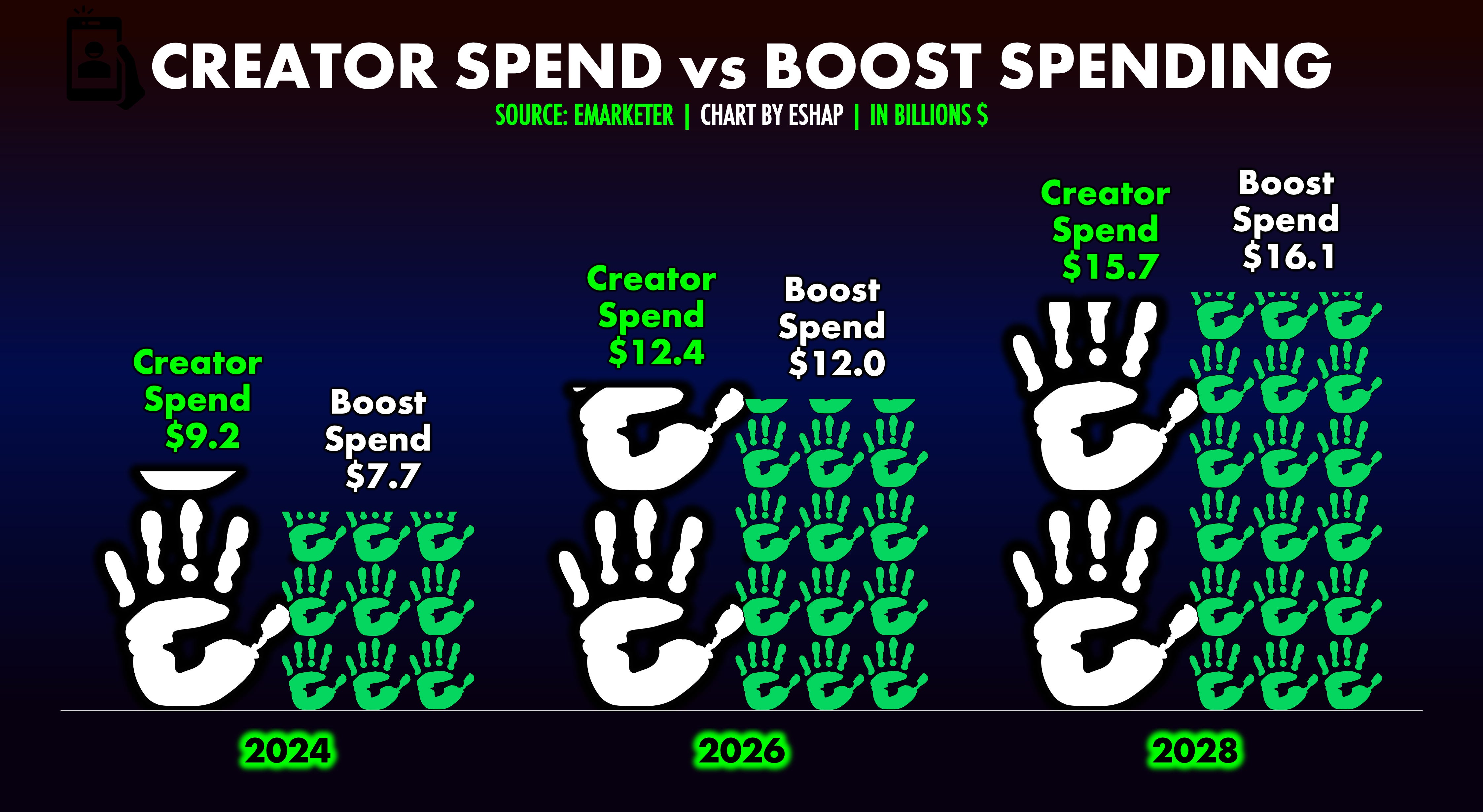
By this time next year, advertisers will spend more boosting Creator content they pay to produce, than they do producing the Creator content itself.
And that plays to my biggest worry for the Creator class who flocked to France: Their time on the Croisette is heavily borrowed. The moment the trend winds shift, or the second agency and brand C-Suites think that enterprise AI tools can generate synthetic influencers for pennies on the dollar, the human Creators will be tossed in the sea in favor of the next young, hot, automated thing.
The ad biz didn’t democratize creativity by inviting Creators to Cannes; it just brought its next target for labor exploitation out to the beach for a glass of rosé before the eventual betrayal. Thus, my warning to the Creator Class: Watch your backs and build your own brands. Many of the agencies now hiring you, do not actually value you.
I had great conversations. I met wonderful people. We discussed some real shit. But inevitably, every discussion turned to the massive fog of cognitive dissonance that had settled across the south of France: the ad industry’s abject resistance to reform itself.
No, the irony-verging-on-hypocrisy of my eviscerating the very festival I was just paid to attend is not lost on me. I understand the risk to my own income by writing this. So why write it down? Because this is the very kind of inconvenient truth I get paid to tell.
The lies the ad world told to win its own awards are simply symptomatic of the great obfuscation at the core of its business model. If we audited the entire ad industry and punctured the corruption at the core of its dealmaking, the way Cannes Lions did with its awards, the entire global marketing illusion would spontaneously implode.
The ad industry spends money on the wrong things: outrageous boondoggles; artificial imagination that no one asked for; mergers that only move deck chairs and make bankers rich. The corruption in the back rooms of these boondoggles burns up resources that we could otherwise invest in a sustainable infrastructure and, crucially, in our own people.
This is how the ad industry keeps its sorry, stale, legacy measurement, long past its sell-thru date — despite literally everyone knowing that it’s all bullshit. This is why legacy can’t manage to evolve, despite an aging, shrinking audience. This is why advertisers still let digital platforms grade their own homework, despite one in five of ad dollars being wasted on fraud.
What if we all went to Cannes BUT DID NOT BUILD MASSIVE CASTLES IN THE SAND? (Like every other conference in Cannes, btw.) What if we mandated that half of what we spend yearly on Cannes was instead redirected into retraining people in the ad industry who’ve been shitcanned this decade? Could we somehow manage to throw ourselves a party that cost only $150 mil? What if we just skip Cannes Lions for two years, and reinvest that $600 million into a new, cross-screen system of measurement? Just imagine.
Nearly all advertising uses poetic license. But the advertising industry has lost the thread. They’ve let the lies they tell themselves become the industry norm. The Mad Men have forgotten the art — and artists — inside the science. They’ve turned the “Festival of Creativity” into The New Roaring 20s.
No doubt, the party was great. But I left this year’s Cannes Lions, more than ever, feeling that the dance was far too manic, and that a crash is coming.
Just me? Let me know what you think.
Which reminds me: I used Cannes Lions, in part, to raise funds for The Ghetto Film School, who teaches deserving students from untraditional backgrounds, film curricula at the university level. Join me?
And don’t forget to enjoy the week!
ESHAP