

55 IS THE NEW 35
How Our Generational Dynamics Are Changing Media

Happy Monday Peaceniks. Ready to drive under 55?
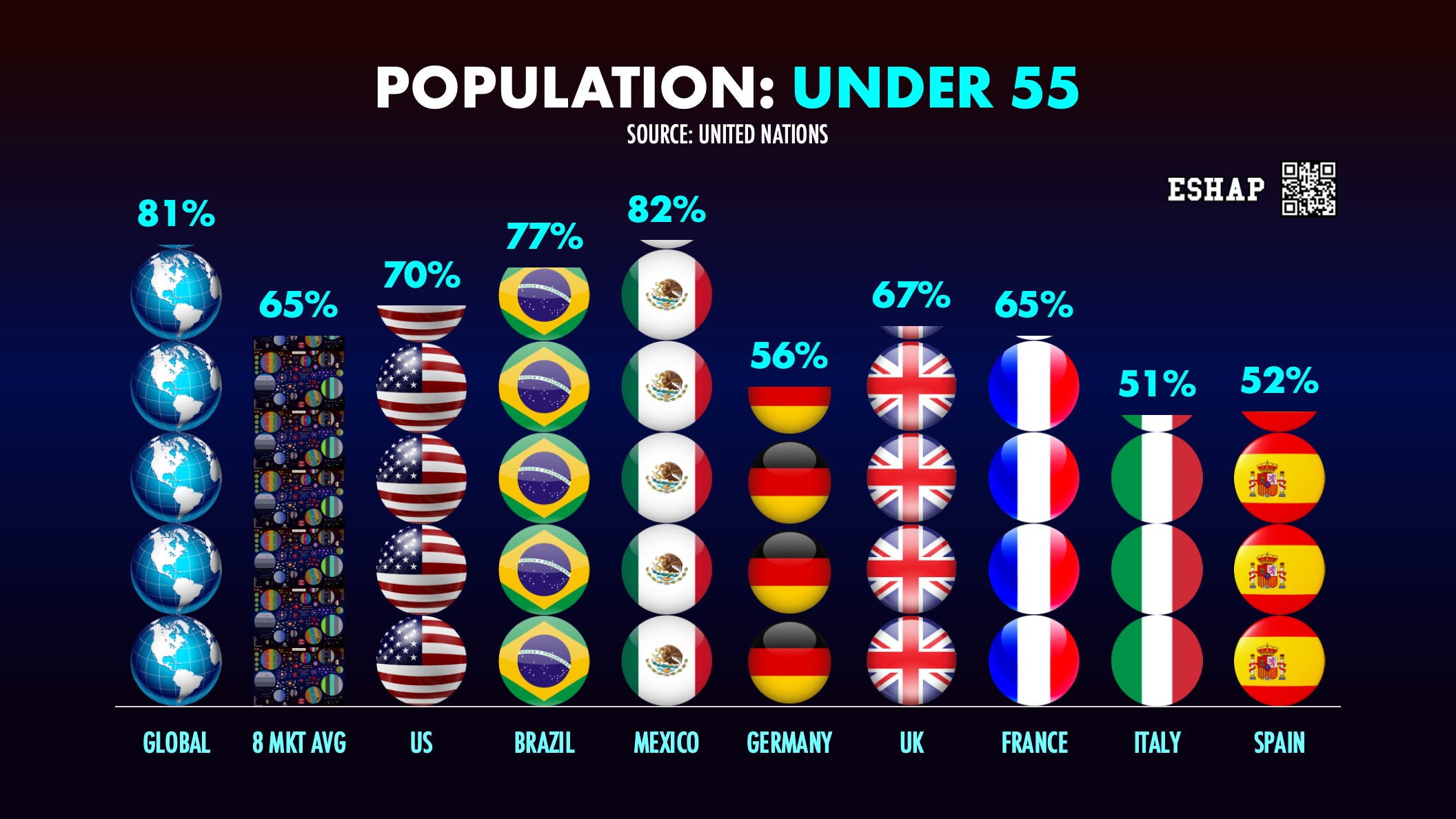
Of all the gravitational forces in the Media Universe, by far the most powerful is the dramatic tilt of the planet’s generational axis from Baby Boomers and Gen X to Millennials, Gen Z, and Gen A.
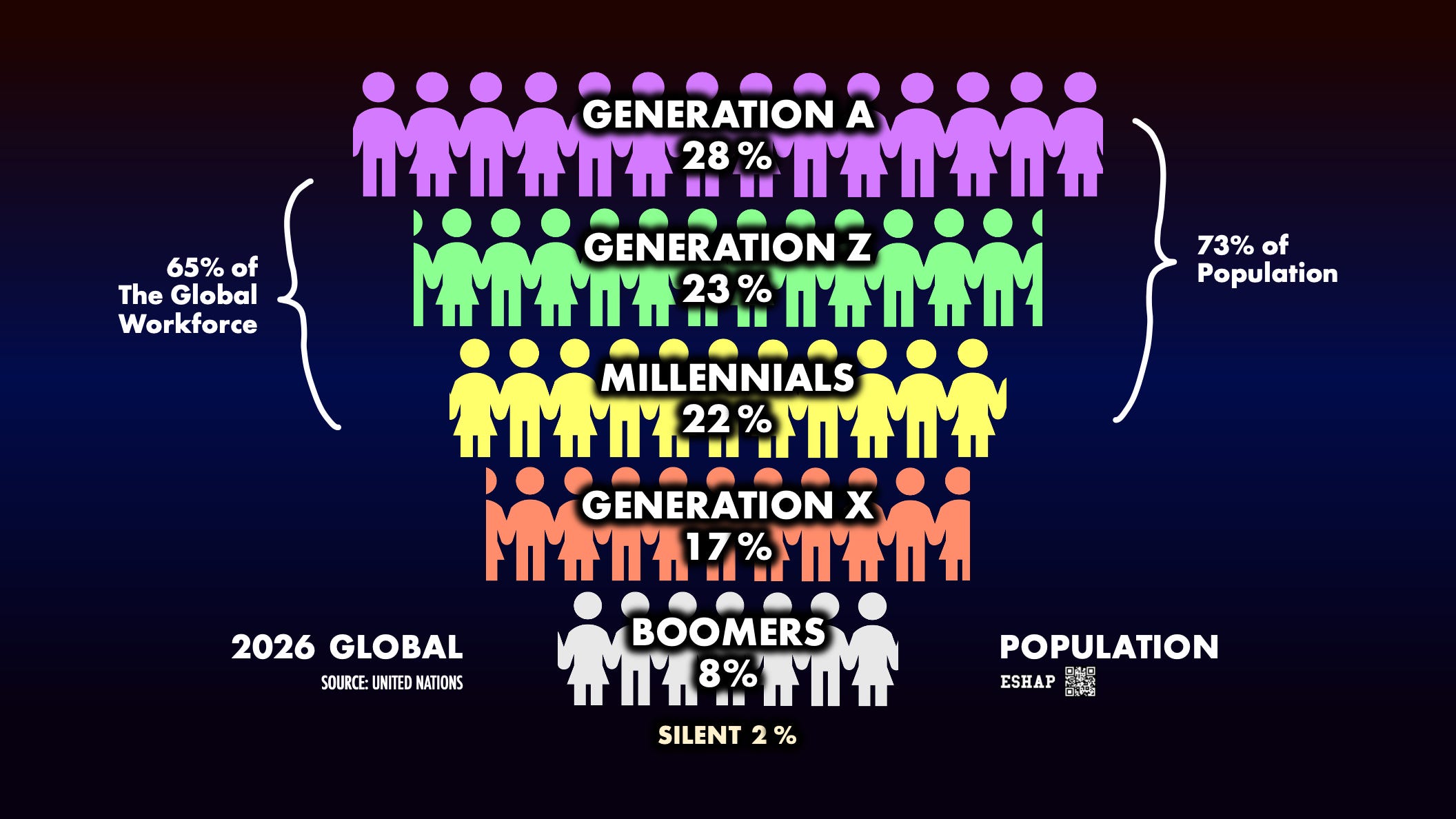
Among Media’s power elite, there is a massive misunderstanding of who actually populates the planet and how that one factor has upended Media consumption in every region on the planet.
81% of the world’s population — 70% in the US, 67% in Europe, and 81% of Latin America — are now under 55.
I chose the 54/55 axis point as a focus of this study for a very specific reason. The generation gap for Media consumption between those over and under 55, in these eight major regions, is massive — and widening.
The data I’ve posted below comes from the ESHAP Cross-Screen Attention Index: The first zero-sum, wholly-deduplicated map of human attention in history. The index is a free, interactive app that allows you to see the total attention, by generation for eight major markets around the world.
In the last week, The Index has gotten a lot of attention from Media pros in these markets.

It’s also managed to upset a number of executives in the Measurement Industrial Complex, because I’ve used their publicly available data, cross-collateralized with handset data and consumer panels from those regions, to show that our collective TV measurement is a mirage.
Why? For two reasons.
Traditional measurement companies in these regions all assume that if a TV is turned on, that it’s actually being watched. Think about your own media habits to understand the fatal flaw in this assumption. Three quarters of all consumers watch TV with a phone in their hand. Most audiences, often or always, are using those phones to look at something else rather than the television screen. Contrary to conventional Media wisdom, it is not possible to pay attention to two screens at once — attention, in fact, cannot be divided.
These organizations are either Joint Industry Committees (JICs) controlled by the companies whose very survival relies on inflating TV tonnage over mobile realities, or for-profit corporations whose massive fees are disproportionately paid by those same companies. As a result, their math skews towards over-indexed TV consumption by the eldest people in those countries, who watch-max for television usage over social video consumption. This is exactly how the world’s major television platforms have found themselves locked inside a geriatric trap of their own making.
Naysayers — all of whom work for or with traditional measurement organizations, by the way — have taken some exception to our methodology. You can see their vague critiques in my comments section (here). Yet none of them, when asked, could point to specific data from their own platforms to contradict our findings. They simply do not like that I have used their very own data to show the innate flaws in their own data, and want me to stop.
If you know me at all, you’ll know I can’t stop and won’t stop. I encourage you to click through to the Cross-Screen Attention Index and look at all the data — and methodology — yourself.
However, for the visual learners out there, below I’ve posted a set of infographics, comparing the time and attention spent on the major platforms between the cohorts over and under 55 in the US, the UK, Germany, France, Italy, Spain, Brazil, and Mexico, from December of 2025 through May of 2026.
In these charts, you’ll see two things: the huge gap between generations of audiences around the world; and the urgent need to accurately measure attention across all our screens.
The 55+ audience spends a disproportionate amount of time and attention on Trad Media. They consume more television than all the other generations.
However, when you zoom in on audiences under 55, you will note that the top-four most-used platforms are YouTube, TikTok, Netflix, and Instagram — with the exceptions of Brazil and Mexico, where national broadcasters replace Netflix in the top four.
In fact, in all eight regions, TikTok beats Netflix for total attention among all consumers under 55, and surpasses the rest of traditional media in every region except Brazil and Mexico.
US
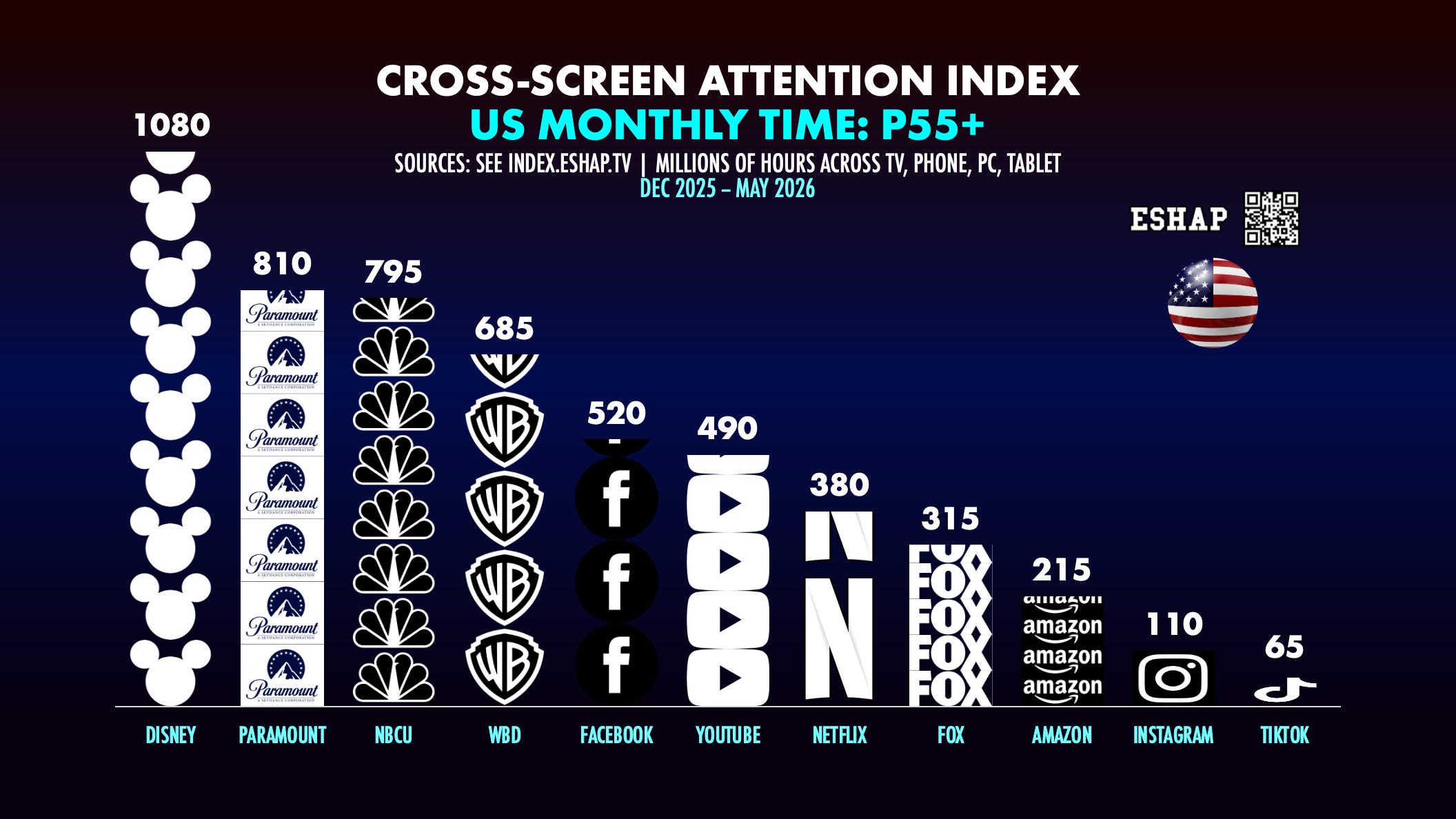
The rest of this post is only available to Premium Peaceniks. To unlock the full, volume-weighted telemetry for all these regions, you’ll need to upgrade.
Keep reading with a 7-day free trial
Subscribe to Media War & Peace to keep reading this post and get 7 days of free access to the full post archives.